Friday, October 12, 2012

Bouchercon 2012

by L.J. Sellers, author of provocative mysteries & thrillers  
Bouchercon was terrific for me this year. I finally felt like a real author with a wide reader base and respect from other authors, even though the conference programmer didn’t offer me a panel until I politely pointed out that I met all the criteria. But in the long run, it didn’t matter.

My highlight this year was having dinner with the Thomas & Mercer team and getting to know Andrew Bartlett, the acquisitions editor. At that dinner, I also met Blake Crouch, Sean Chercover, and Dana Cameron, and walked back in the rain with with Tom Shreck, whom I’ve known since we were both with the same small press. (Blake and Tom are in a lower photo.)

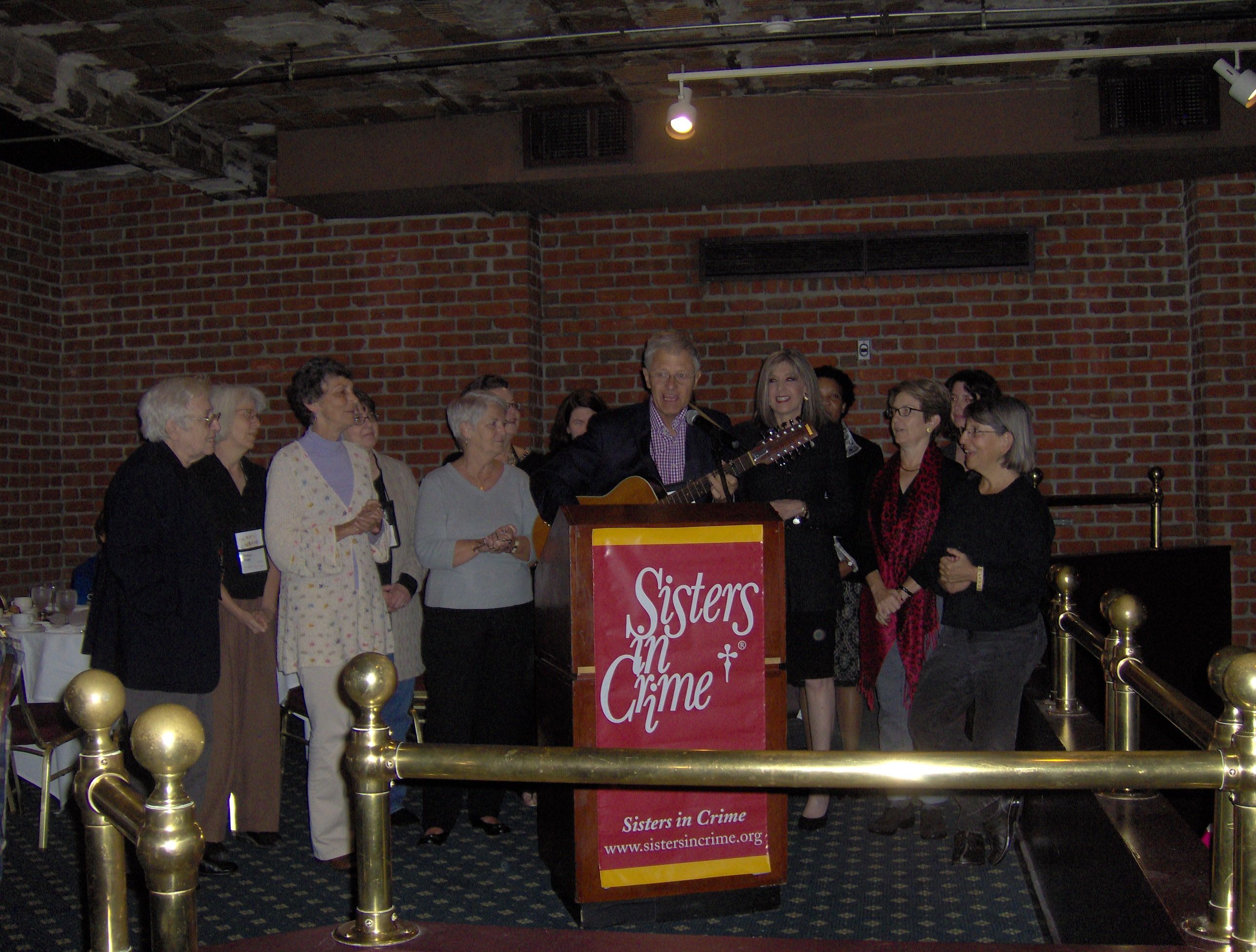
But let me back up. I started Friday with a Sisters in Crime breakfast, complete with singing a chorus of “You show me your gun, I’ll show you mine.” Then I attended a panel called Old Friends, New Friends, nicely moderated by Jen Forbus, followed by Eve of Destruction—with authors Sophie Littlefield, Deborah Coonts, Tracy Kiely, and Rochelle Staab—who talked about their kickass female characters.

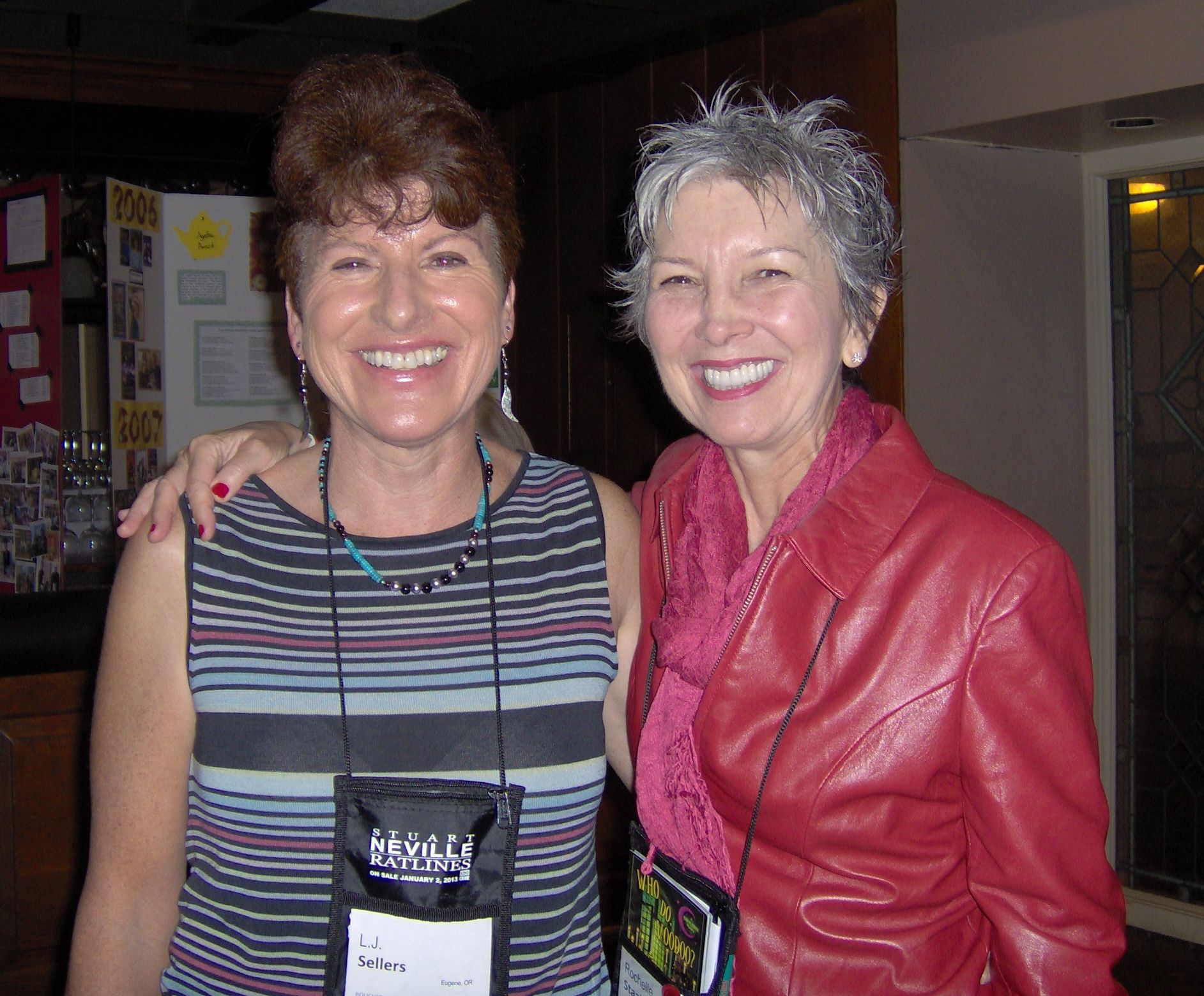
I spent a lot of time with Rochelle, who I’d Skyped with earlier in the year for a Big Thrill feature. She’s just as dynamic in person. (Bottom photo in gorgeous red leather.) A little later I met up with longtime online friend Debbi Mack for the first time—lovely woman—and had lunch with her and fellow panelist, Conda Douglas, and new author friend, Molly Cox Bryan. Friday afternoon, I attended Men Are From Mars, Women Are From Venus, a terrific panel where they talked about writing from the opposite gender’s perspective. The room was packed to see Elizabeth George, Val McDemid, Alan Jacobson, Tom Shreck, and another friend, Alexandra Sokoloff. The moderator, Daniel Palmer did a great job of keeping it lively.

Saturday was a day of conversations. I chatted with readers and authors all day—including Zoe Sharp, Julie Hyzy, Claudia Whitsitt, and Annette Dashofy —and had lunch with my terrific roommate and author Terry Shames (top photo), along with Keith Raffel, Boyd Morison (and his wife Randi) Tracy Kiely, and another delightful author whose name escapes me. By that point, I’d met and chatted with so many people, it was hard to mentally keep everyone straight. We talked shop, but also veered off into other stimulating subjects.

Still, that evening at the awards ceremony, I met more authors for the first time. Edgar nominee Darrell James was charming, and so was Kathy Wiley and new author Anne Cleeland. I went to dinner with Darrell James and a female author named Darrell who writes under the name Avery Aames, as well as Rochelle, Terry, Dana Cameron, Roberta Isleb, and another woman I should remember. I also chatted with numerous authors in the bar that evening, staying up late to connect with as many people as possible.

That’s the problem with blogs like this. I can’t possibly mention everyone I talked even if I could remember all their names. So if I left you out, please don’t be offended, and feel free to comment and remind me! And I have to mention that I chatted with Stan and Lucinda Surber who talked me into being a chair for Left Coast Crime 2015 in Portland. It'll be fantastic, so put it on your calendar.

The best panel I attended was on Sunday morning and called Red Herrings. Moderator Keith Raffel (a great guy!) was sharp and funny, despite a late night in the lounge, and the panelists—Beth Groundwater, Pennie Ross, D.M. Pirrone, and Melodie Campbell—all kept up with him.

Afterward while waiting to leave, I chatted with agent Janet Reid, who did her best to convince me that personal one-to-one emails are worthwhile, even with a thousand-name email list, and I know in my heart she's right, even though the task would be overwhelming.


And I shared a cab to the airport with Gigi Pandian, an delightful author I shared a shuttle with at B-con 2010. We both seem to fly home to the west coast at the same time I also talked with people on all of my flights coming and going, two of whom have already emailed me, hoping to stay in touch. I wish I had total recall for all the wonderful people I’ve met.

If you attended B-con, please share one of your moments.

Thursday, October 11, 2012

Are you a conferee, a conventioneer, or a little bit of both?


By Gayle Carline

On Monday, Jodie Renner gave us a wonderfully organized list of writers’conferences and conventions, and in the comments, Jeri Westerson pointed out there is a difference between the two.

As well I know, having been to both.

Writers’ conferences are for writers, and by writers, I mean anyone who might even be thinking of writing but is not certain if they are ready to sit in front of a blank screen or sheet of paper and open a vein. All genres are welcomed, discussed, deconstructed and built anew. The nuts and bolts of the writing business are presented, from the craft of writing to the logistics of business. The rooms have tables with their chairs, so you can take notes comfortably.

At least, a good conference should do this. If every evening ends at the bar, telling jokes, swapping bad publishing stories, and juggling swords, well, that’s a bonus. And if there is an impromptu field trip to a porn store, you’re looking at a trifecta.

My first writers’ conference was in Palm Springs and it’s where I got the idea for Freezer Burn. Subsequent conferences taught me how to write a damn good book, how to find a publisher, and ultimately how to publish and promote my damn good books by myself.

Conventions, on the other hand, are where authors meet their readers, both old and new. They are, as a rule, genre-specific. There are several mystery/thriller conventions, from Bouchercon to Love is Murder to Left Coast Crime and beyond. Romance authors have their soirees, as well as sci-fi/fantasy, and I’m guessing YA and/or children’s books.

Conventions are about panels. The chairs are set up in rows and there are no tables, so the taking of notes, while not discouraged, is not expected. There will be no exam later. Four or five authors sit at a table and a moderator asks them questions for most of the 45 minutes, leaving about ten minutes for questions from the audience.

I’m pretty sure this is to keep the audience from telling long-winded tales of their own that don’t really have a question attached. Sometimes it works.

A convention also has an entire room full of booksellers, so if you have never read an author, but see her* on the panel and decide to check out her books, you can buy one and hunt her down for an autograph. (*Or him, but I really like it when it happens to me.)

A really good convention begins with a continental breakfast and ends at the bar, telling jokes and swapping bad publishing stories. (There might be sword juggling, but I’ve never witnessed this.) And even though I’ve been to two conventions and have yet to go on a field trip, it would not be out of the realm of possibility.

This is when it would suck to write literary fiction. No convention, no drinks with people who love your work despite the fact you’re a jackass, and no field trips.

At my first convention, which was Bouchercon, I spent one evening sitting at a table, watching a steady stream of authors and their friends come and go like a tide. LJ Sellers and CJ West sat down. Gary Phillips arrived and LJ left. CJ left and someone else arrived. It was like an entire night of cameo appearances. The high point was when Lee Child sat down next to me. He was so darned sweet and gracious, you wanted to take him home to meet your mother, just to prove to her that you knew someone with a lick of manners.

At my second convention, Left Coast Crime, I didn’t meet Lee Child, although I did get to schmooze with Gary Phillips and LJ and a bunch of fun-fun authors. But the best was Sunday morning, when I was waiting for a seat in the uber-crowded cafĂ© and a group of readers waved me over to sit with them. Three women who didn’t know me from Adam/Eve and had never read my books, asked me tons of questions, requested my card and bookmarks, and made me feel like an Author. I was as tickled to be with them as they were with me — how cool is that?

Obviously, I find something in both kinds of gatherings that feeds my creative soul. Now that I have described them both to you, which ones do you like to (or wish to) attend, and why?

Wednesday, October 10, 2012

Have you lost the plot?

By Jenny Hilborne, author of mysteries and thrillers.

I have a chaotic mind and a tough time focusing on one thing at a time. I'm an erratic thinker with a short attention span. I often wonder how I got from one point in the thinking process to another. I'm a disorganized author.

When I sit down to write, my thoughts are scattered and my energy races off in several different directions, the result of which is a complex story with more than one plot line. These are the types of novels I mostly enjoy reading.

The challenge with a complicated story and multiple plot lines is the tendency to introduce the reader to a large cast; Stieg Larsson's series comes to mind. In Hide and Seek, I chopped out 14 characters during the editing process; enough to star in a novel of their own. I was still left with 41. I don't know what the optimum number of characters is. Each one in Hide and Seek had a purpose, and each earned their place in the story, but I would have preferred to write with a smaller cast.

A larger cast is more difficult to memorize, at least until the framework of the story is understood. This was part of the reason Dragon Tattoo took me several attempts before I stuck with it. If an author makes a reader do too much work, the reader might give up and move on to another book.

Another challenge with parallel plot lines is getting the threads to merge. In Madness and Murder, my two plot lines merged well and clues were dropped early on to show the reader how they would blend. I left the reader with questions, and the promise they would be answered. It's not always easy to get sub-plots to merge, as I've discovered with my new novel, Stone Cold, a current work in progress.

Stone Cold has a much smaller cast, but the sub-plot has grown legs of its own and taken over the main plot. I'm left wondering whether to cut the main plot and use it in another novel, or continue to try to blend them. Both plots have emerged as strong stories. As an author, I'm wondering what my readers might prefer. I love the complexity - do they? As the storyteller, I must choose how to tell the story, but a wrong choice could fail to draw the audience into the world I've created. I've agonized over it for weeks.

Reading authors such as Stieg Larsson can be work (and well worth it, once I got past the challenges he presented). I imagine writing his books and keeping track of the immense cast was not easy, but each character moved the story and he knew how to tell it. Authors have voices and stories in their heads, but who knew getting them on paper could be so difficult?

Authors: what traits of your personality make writing a challenge for you?

Readers: How complex do you like your mysteries and thrillers? Does a story with more than one main character and more than one plot line make it too difficult to follow the action?


Tuesday, October 9, 2012

Understanding the Chain of Custody

Chain of Custody is is a legal definition that many people outside the law don't understand. I see it commonly misrepresented in print and on the big screen so I thought it might be helpful to explain it (at least how it is understood in the United States). As an author you might think that this topic is too wonky. Most readers won't know the difference so why venture into the tall grass right? There's a ring of truth to that line of thinking but, understanding the chain of custody can help you drive a story by introducing conflict. Breaks in the chain of custody can do the same thing in real life!

Basically, the chain of custody is a record of who had possession of each item of evidence at any given time. Notice I say possession and not just proximity, that is a legal difference. More on that in a bit. It is a mechanism to demonstrate that the evidence has been protected and further, who had possession of it so they can be interviewed about their actions if need be. The chain begins the moment the evidence is collected until it is presented in court before the jury. Between those two events the custodian (the person responsible for the evidence) must demonstrate how the integrity was maintained. Law enforcement agencies do this primarily through two mechanisms.

The first is maintaining a written log. The log begins with the first person to collect the evidence from the crime scene, victim, suspect, etc. The form will describe the item (in detail) and have spaces for the names, dates, and times, the evidence changes hands. So as a CSI I may be the first to sign the form. When I "book" the item into the property bureau then the technician or clerk receiving the item will sign for it and I will sign it in the "released by" space. So when reviewing the form you'd be able to determine each and every person that took possession of the item and how long they had possession of it. These forms can list a number of items (say up to twenty) from the same crime scene but each item will have a unique number. Modern agencies use bar code systems but there may still be a physical signature or digital (coded) signature.

The second mechanism is the evidence packaging. When an item is packaged the custodian will seal it with either evidence tape (paper bags/envelopes) or a heat seal (plastic bags). The custodian will then sign their name, employee number, and date across the seal. That way if a lawyer questions whether or not the item could have been accessed by someone not on the form all you have to do is examine the seals. When I testify in court and introduce evidence is it common for me to have to examine a sealed bag and verify my signature and date before opening it for the jury. If I have to examine an item that has been sealed by another person then I always make a new opening (cut) away from the original seal. That way I don't damage the original.

If a bag is found to be opened or the items are unaccounted for then the chain is considered to be broken. The integrity of the evidence is dependent on the item, regardless of location. So, hypothetically speaking, leaving an un-bagged murder weapon unattended in the hallway of the police department would constitute a break even though the area is "secured". However, if the seal on an evidence bag is unbroken the same item could conceivably be left in a public place without compromising it (although there would still be one hell of a legal fight). In the first example you couldn't demonstrate that the item wasn't tampered with. In the second example you may be able to.

This brings me to an important distinction. Oftentimes I have seen writers describe the chain of custody as "broken" simply because someone came into contact or proximity of the evidence (even when sealed in bags), Usually this is not the case. Consider evidence sent to the FBI crime lab in Quantico, Virginia. Most agencies have to mail their evidence to the crime lab. There is no legal requirement to have each and every mail carrier handling the box to sign a chain of custody form. Tow truck drivers don't sign for vehicles. Likewise, every detective or CSI that enters the property warehouse doesn't have to sign for each item in there just because they came into the vicinity of it. It is only required when you are in a physical position to alter or damage the evidence through physical contact.

So why do I care about this Tom? Boooring! I agree that 99% of the time chain of custody issues are tedious and mundane. But, those moments when the chain is broken can lead to massive fireworks. A compromised chain may force a judge to exclude certain evidence. If that evidence is the murder weapon or a surveillance tape then the whole case may go up in smoke! These mistakes most commonly occur with outside experts unfamiliar with the chain of custody issues. Take a university professor for example. Maybe they are the leading expert on aquatic snails (glamorous I know), the same type you found on your murder victim. This guy may have never worked on a forensic case in his life (or kissed a girl) so the whole experience can be quite exciting. He may not realize that leaving your evidence in his lab where all his grad students and anyone capable of turning a doorknob could gain access to the evidence. Hell, he may even show it off.

These breaks are even more devastating when they are "discovered" during the course of testimony. Imagine the look on the prosecutor's face when they learn their key evidence was compromised! The break in the chain may be unintentional or an act of sabotage. Other occupations that may contribute to a break in the chain could include private investigators, defense experts, or tow truck drivers. I remember a case (not mine thankfully) where an agency towed a suspect vehicle to a storage lot intending to search it the next day. They locked the vehicle but the suspect had a spare key. That night he scaled the fenced lot and stole his own vehicle back! As writers, you can get as creative as you want. A break in the chain of custody can alter the course of a story in much the same way it can alter a case. Evidence can become useless and investigators may have to go back to the drawing board. This all adds up to a ton of conflict and conflict keeps the reader engaged and itching to turn the page. Tempers flare, careers are lost, bad guys get away with crimes, cats and dogs cohabitate; it's a real mess! So get creative and most of all, have fun with it!

Friday, October 5, 2012

Angst and Other Things Authorly


by Peg Brantley


When I slid over to the serious side of writing in 2004 and began learning a little bit about the craft, it became necessary to suck “Id” up and let other people read the words I’d written. The wait was terrible as my critique partners made their way through what was certainly mangled and bruised and very purple-y colored prose.

Fast-forward eight years to the beginning of 2012 when my first novel was published. I was torn between wanting everyone to read it and hoping no one would. People who knew me and had certain expectations of my abilities would read my book—and I would no longer be able to fool them. They would shake their heads at how easily they’d been conned. Publishing a book that proved I was not really as talented as I pretended was a very different way to come out of the intellectual closet. Almost as bad was the thought that complete strangers would read my novel and pass judgment on me within minutes. They wouldn’t even give themselves a chance to get to know the phony me. The angst loomed so large that I questioned any positive comments believing they were merely politely phrased pity.

So now, here I am, less than two weeks away from the release date for novel number two, The Missings. (No, I don’t write that fast. This was a manuscript that was written prior to Red Tide. I just needed to go back and apply things I’d learned.) I’m sure I’m going to disappoint some people who have been waiting for a series. (Go figure. I guess they did like the book.) I’m using the same fictional town but different characters. I’m going to disappoint some people who expect another thriller. Number two is a police procedural. And there’s only one dog in it and he’s not exactly in the spotlight. (Red Tide has some hero-dogs.)

The angst began early for this one and it’s building. I’ve sent the book out to beta readers. Their feedback came in and when there were pages and pages without comment I was sure they were bored and had skipped entire scenes. I had lost the pace or the story or whatever and therefore, I lost a reader. Never mind that I asked my enlisted volunteers to watch for that sort of thing in particular. Never mind that they told me they loved those pages. I was convinced I was doomed.

The next item on the agenda was a professional edit from Jodie Renner (who was a joy to work with, by the way). It's now been formatted for Kindle, has been endorsed and reviewed and soon it will be time for that huge and final, no-going-back step. The step that requires me to jump off a cliff and knit wings on the way down.

The step requires me to trust the process. Trust that my meshing of words will find the audience they were meant to find. Trust that my book will provide as much entertainment as the next authors. Trust that I will live to take another breath and write another book and have the wonderful opportunity to be just as unsure about everything all over again.

Whatever it is you do in your life, if you feel moments where you are vulnerable and scared, then you’re doing something significant. It might be as large as saving thousands of lives, or as small as writing a book that gives people a few hours of escape into someone else’s life.

I’ve come to embrace my angst. Well, sort of. But I’ve pretty much concluded that if the angst leaves entirely, it might be time to move on.

How about you? Are you ever filled with angst? Or a little bit of dread? I’d sure love to have some company.


Peg Brantley's debut thriller, RED TIDE, has found it way into the hands of more than 35,000 readers in the six months since its publication. THE MISSINGS, a police procedural, will be available soon.


Thursday, October 4, 2012

SAFECOP – a New Weapon in Tampa’s Arsenal

Guest post by Kelly Miller
The crime fighters in our novels don’t rely on Ouija boards to capture the bad guys. They use the latest technology available. If you write crime fiction, it’s imperative you familiarize yourself with the systems police departments across the country use.

When the Republican National Convention came to Tampa, Florida, last month, the Tampa Police Department was thrust into the national spotlight. Chief Jane Castor and her officers performed exceptionally well under the stress of picketers and two weeks of twelve-hour shifts. There were even Tampa residents interviewed on the local news, complaining how quiet downtown was during the RNC. If that was the worst criticism of the week, I’d say the TPD exceeded expectations.

One benefit of the convention was the purchase of a $400,000 software upgrade from Congressional money set aside for convention security. This technology allows Tampa officers to continuously scan updated maps for crime trends. When police respond to a crime scene, they enter the information collected into the system and Tampa maps are updated instantaneously. This software also allows officers access to maps showing career criminals, sexual predators, and juvenile offenders living in a specific area.

In the past, if the TPD wanted to send out a BOLO (Be on the Look Out), it could take several hours or even days for officers to receive the information. Now alerts happen in real time. Investigators can send out these bulletins using the new software as well as post photos and videos.

Shortly after the RNC, the bay area got to see this new software in action when a burglary suspect was arrested. Reportedly a man broke into an office building, ransacked the place, and stole cash and audiovisual equipment. Burglary cases often take at least a few days to solve, if solved at all. But this suspect was arrested in only two hours. Police checked the burglarized company’s surveillance video and found an image of the suspect. An officer used a cellphone camera to take a picture of the man in the video. Then the photo and a description of the suspect were entered into the new system and it quickly lead to his capture.


Kelly Miller’s first novel, Dead Like Me (due out November 29), is set in Tampa, Florida where she lives. This technology isn’t something her detectives use, but the third book in the Kate Springer series will be set during this time period—September 2012. Kelly is hoping the backdrop of the RNC and new technology like SAFECOP will add extra flavor to the story. Please visit Kelly's website and her blog.

Tuesday, October 2, 2012

The Two Things Every Novel Needs


by James Scott Bell, bestselling author http://jamesscottbell.com/      

"Trouble is my business." – Raymond Chandler

So you want to be a writer. You want to sell your novel to a publisher, via an agent, or maybe you're thinking of going indie like 90% of sentient beings these days. Maybe you think if you do the latter, and do it fast, you'll rake in a boatload of easy lettuce.

Well, you won't. Unless your book has the two things every novel needs.

Without these two things, you will have no story. At least, no story most readers will care about. You might have an "experimental novel," and that's okay if you understand what experimental novel means. It means a novel that five people buy. (Please note: This may not matter to you, and that's perfectly fine with me. Experimental artists have given us some good stuff over the years. A lot of bad stuff, too. But if that's your corner of the artistic world, go for it. This is America, after all).

But if you want to sell your work and have a shot at generating income, you need to master these two elements.

They are Conflict and Suspense

Conflict
What is the goal of the novel? Is it to entertain? Teach? Preach? Stir up anger? Change the world? Make the author a lot of money?

It can be any of these things, but in the end, none of these objectives will work to their full potential unless they forge, in some way, a satisfying emotional experience for the reader

And what gets the reader hooked emotionally? Trouble. Readers are gripped by the terrible trials a character goes through. (There are psychological reasons for this that are beyond the scope of this post). 

That's where conflict comes in. While there are writers who say plot comes from character, let me say that's too simplistic. Character actually comes from plot. Why? Because true character is only revealed in crisis. Put your character into big trouble (plot) and then we'll see what he or she is made of (character). If you don't believe me, imagine a 400 page novel about Scarlett O'Hara where she just sits on the porch all day, sipping mint juleps and flirting. Gone With the Wind only takes off when she finds out Ashley is going to marry Melanie (trouble) and then the Civil War breaks out (big trouble!) 

Another way to think about it is this: we all wear masks in our lives. A major crisis forces us to take off the mask and reveal who we really are. That's the role of conflict in fiction: to rip the mask off the character. 

Now, this conflict must be of sufficient magnitude to matter to readers. That's why I teach that "death stakes" must be involved. Your Lead character must be facing death—which can be physical, professional or psychological.

Genre doesn't matter. In a literary novel like The Catcher in the Rye, it's psychological death. Holden Caulfield must find meaning in the world or he will "die inside." Psychological death is also the key to a category romance. If the two lovers do not get together, they will lose their soul mate. They will die inside and forever have diminished lives (that's the feeling you need to create. Think about it. Why was Titanic such a hit with teen girls? It wasn't because of the special effects!)

In The Silence of the Lambs, it's professional death on the line. Clarice Starling must help bring down Buffalo Bill in part by playing mind games with Hannibal Lecter. If she doesn't prevail, another innocent will die (physical death in the subplot) and Clarice's career will be over.

And in most thrillers, of course, you have the threat of physical death hanging over the whole thing.

That's why, novelist friend, trouble is indeed your business. Without sufficient conflict readers aren't going to care enough to finish the book.

Suspense

The second element is suspense, and I don't just mean in the suspense novel per se. Suspense means to "delay resolution so as to excite anticipation." Another way to say this is that it's the opposite of having a predictable story. If the reader keeps guessing what's going to happen, and is right, there is no great pleasure in reading the novel.

We've all had the wonderful experience of being so caught up in a story that we have to keep turning the pages. This is where writing technique can be studied and learned and applied. For example, there are various ways you can end a chapter so readers are compelled to read on. I call these "Read on Prompts," and it was one of the first things I personally studied when I started learning to write. I went to a used bookstore and bought a bunch of King, Koontz and Grisham. When I'd get to the end of a chapter I'd write in pencil on the page what they did to get me to read on. 

Invaluable.

Again, genre doesn't matter. You have to be able to excite anticipation and avoid predictability. Suspense technique helps you to do that.

I am so passionate about this that I wrote a book on the subject, and Writer's Digest Books published it.  

I could go on and on about this subject, but we don't want to overstuff one blog post. Suffice to say that if you were to concentrate almost exclusively on these two key elements for the next few months, your books will take a huge step toward that exalted "next level" everyone always talks about. Try it and see.     

JAMES SCOTT BELL is the author of the #1 bestseller for writers, Plot and Structure, and numerous thrillers, including Deceived, Try Dying and Watch Your Back. His novella One More Lie was the first independently published work to be nominated for a prestigious International Thriller Writers Award. Under the pen name K. Bennett, he is also the author of the Mallory Caine zombie legal thriller series, which begins with Pay Me in Flesh. He served as the fiction columnist for Writer's Digest magazine and has written highly popular craft books for Writer’s Digest Books, including : Revision and Self-Editing, The Art of War for Writers and Conflict and Suspense.
Website: http://jamesscottbell.com/


Monday, October 1, 2012

When Writers Don't Deliver

A guest post by Tess Gerritsen.


It's every aspiring author's dream. A publisher offers you a big contract for your next book, the deal gets announced to the press, and you receive a check as an advance payment. Now all you have to do is finish writing the manuscript, send it to your editor, and presto! You're a published author.

Or not. Because a lot can go wrong between signing the contract and your book's appearance in stores. I was reminded of just how often things do go wrong when I recently came across this article:

A New York publisher this week filed lawsuits against several prominent writers who failed to deliver books for which they received hefty contractual advances, records show.
The Penguin Group's New York State Supreme Court breach of contract/unjust enrichment complaints include copies of book contracts signed by the respective defendants.

Among the five authors mentioned in the article are Prozac Nation author Elizabeth Wurtzel, who signed a $100,000 deal in 2003 to write "a book for teenagers to help them cope with depression," and blogger Ana Marie Cox, who signed a $325,000 contract in 2006 for a humorous book about political activists.

I don't know the particular circumstances of these authors. Perhaps personal issues -- a divorce, a severe illness, or unremitting depression -- kept them from delivering the promised manuscripts. Perhaps they did in fact deliver the manuscripts, which was deemed unsatisfactory by the publisher and rejected.

Or perhaps they suffered from an all-too common writer's malady: crisis of confidence. I know all about it, because twenty-five years ago, it almost derailed my budding writing career.

I had just sold my first romantic thriller, Call After Midnight, to Harlequin Intrigue. The book sold well and was nominated for a Rita award. Although I didn't sign a contract for the next book, my editor anxiously waited for my second novel. And she waited. And waited.

Two years later, all I had to show her were partials of various abandoned novels, stories that started off well enough, but within fifty pages had run out of steam. I just couldn't finish that second book. The months went by and my panic grew. This wasn't just writer's block; this was a full-stop career block. I was doomed to join the crowded ranks of one-book wonders.

I don't remember how I got past those dark months. What I do remember were the calls from the editor, the sound of disappointment in her voice when I told her I still didn't have anything. Eventually the calls between us stopped, leaving editorial silence, a sign that my publisher had at last given up on me. But I hadn't given up on myself, so I kept writing.

What saved me in the end was this: I finally gave myself permission to write badly. I decided it didn't matter if what I wrote was unpublishable, as long as I just kept writing. Up till then, I had abandoned at least three different story ideas within the first hundred pages, because all I could see were the flaws, and I got discouraged. Then I'd get seduced by a different story idea, a brighter, shinier premise on the other side of the fence. And I'd go chasing after that new premise until it too started to show its flaws. I couldn't finish a single book because I wanted it to be absolutely perfect, from beginning to end. From the very first draft. Which is like expecting your child to speak four foreign languages and play Bach on the piano at age five.

Children don't start off perfect, and neither do manuscripts.

At last I pulled out one of my earlier attempts, a story about a woman doctor being sued for a case of malpractice that is, in truth, a murder. The hero is the plaintiff's attorney, whose goal is to destroy her career. It had been months since I'd looked at the story, and suddenly I saw new possibilities. I resumed writing it. This time, I didn't stop to edit, I didn't stop to think: "oh, this part sucks." I stuck to my mantra: Just keep writing. And I did, all the way to the end.

The result was a first draft that was full of inconsistencies and mid-story plot shifts and characters who kept changing. But at least I had a first draft. I had a beginning, a middle, and an end. I had something to fix, and I did. In 1990, Under The Knife was finally published -- three years after my first novel.

In the past twenty-five years, I've written twenty-four novels. I've never forgotten those depressing, desperate months when I couldn't finish a book. Over the years, the writing hasn't gotten any easier; it's hard work, and it always will be. I've learned that I simply have to forge ahead, no matter how awful my writing seems, or how outlandish my plot. Because here's my second mantra: I can fix this. I might need five or even ten re-writes, but eventually I'll make that story work and I'll turn in that manuscript as promised.

Publishers want writers they can count on, writers who are both reliable and consistent. They'll usually give the author a certain amount of leeway if unavoidable crises pop up, such as serious illness or a death in the family, but eventually the contract has to be honored... or else.

And that's what separates the professionals from the amateurs. The professional always delivers.


Tess Gerritsen left a successful practice as an internist to raise her children and concentrate on her writing. She gained nationwide acclaim for her first novel of medical suspense, the New York Times bestseller Harvest. She is also the author of the bestsellers Life Support, Bloodstream, Gravity, and The Surgeon. Tess lives with her family in Maine.

Ms. Gerritsen's most recent thriller, Last to Die is reviewed today on Stuff and Nonsense