Showing posts with label writing novels. Show all posts

Wednesday, June 27, 2012

On Theft and Entitlement

By Andrew E. Kaufman

I’ve had Google alerts set up for my books and my name for years. I like keeping up on where and how my work and I are being mentioned over the Internet. It goes with the job.

But for several years now, I’ve noticed a growing and disturbing trend. The majority of my alerts now come as advertisements for “torrent” feeds offering up my books as free downloads. Generous of them to do so, but unfortunately, it's being done without my permission.


I get these advisories several times a day now, and they always seem to come from different websites. Insidious little bastards, they are, and I can only assume that since the volume of books I sell through approved channels has grown substantially over time, so too have the unapproved ones. There is always a price to pay for success, and this, I suppose, is one of them.

I can also assume that all this means there is probably a very large number of people who are reading my work free of charge. How many? There’s no telling, but according to what I’ve read recently, the numbers could be staggering.

Torrents work by dividing large amounts of data into smaller chunks. Through this process, files like movies and e-books can be disseminated very rapidly and very widely, spanning well beyond the U.S. and into other countries.

Of course, torrents themselves aren’t illegal. What’s illegal is when they’re used to pirate copyrighted materials, and more often than not, that seems to be the case.

Unfortunately, stopping this kind of activity is about as easy as nailing jello to a tree. Many of the sites operate from overseas sites where copyright laws don’t apply. The U.S., in an effort to circumvent this, has started prosecuting people who download copyrighted materials via torrents. Unfortunately, because of the large number of people doing it, the process is cost prohibitive at best. Some companies have also  taken measures by “poisoning” torrents containing their material. Some have even filed cease and desist orders to Internet service providers of torrent users. But again, we’re taking about what amounts to a drop in the bucket when you take into consideration the size and scope of the problem.

Does it bother me that possibly hundreds of thousands of people could be enjoying my hard work without paying? It certainly does. Do I let myself get worked up over it? Not really. I mean, let's face it, pirating is nothing new—it’s been around for ages—and the art of thievery is one that’s even older. Of course, with the advent of the Internet, these efforts become amplified to the nth degree, which does make it more troublesome.

And while I hate to take the “There's Nothing I Can do to Stop it” attitude, I know that there's in fact really nothing I can do—except maybe complain, get all upset, and stomp my foot. But then I just end up with a sore throat and foot, and the behavior that caused it continues on anyway.

But here’s the thing. I'm not worried about the money. Honestly, I'm not. If I were, I wouldn't have given away more than a hundred-thousand copies of my books this past year. What bothers me is when people steal because they feel they're entitled to do so. Kind of like when someone sees your fancy new car in the parking lot at a shopping mall and thinks it's perfectly okay to drive away with it just because they want to. When people steal because feel they deserve what I've worked so hard to get--that's when I start to get miffed. And what about all the wonderful readers who actually spend their hard-earned money on my books? Is if fair to them? Nope.

What do you think? Authors, does it bother you to know people are stealing your work? And readers, how do you feel knowing there are folks out there who are taking what you had to pay for?

Thursday, March 8, 2012

Best and Worst of the Digital Writing Life

By C.J. West

When my last physical was over, my doctor asked, “You still writing suspense novels?”

“Absolutely.” I smiled.

“But what do you do to make a living?” he asked.

If I sold a book for every time I heard that one...

Then yesterday someone asked about my schedule and was surprised that I usually work well past midnight. That’s if you call what I do work. I love writing and if I’m not sleeping, spending time with my kids, or doing chores, I’m working.

My boss is a slave driver!

Work for me can be anything from researching a subject for a new book, writing and editing a novel, to spending time online connecting with friends in the writing community.

Since the writing life is such a mystery to non-writers, I thought I’d shine a light on what my little corner of the universe is like.

The top 10 great things about being a writer in the digital world:

10. Writing connects me with thousands of great people all over the globe.

9. My commute consists of pulling back the covers and stretching to power on my laptop.

8. The digital store is open 365 days a year (366 this year) and I can see exactly what I’m earning minute to minute.

7. Tweeting and Facebooking are important job skills.

6. Blogging about my addiction to chocolate or my attempts to diet earn me readers.

5. My office fits in a carry-on with room to spare. I can work on a beach or plane.

4. When I’m looking out the window and dreaming, I’m doing my best work.

3. My imaginary coworkers can’t sue for sexual harassment and they don’t complain about working conditions or low pay.

2. People write to tell me my writing has changed their lives.

1. The digital explosion has allowed me to reach tens of thousands and earn a living doing what I love.


Ten worst things about being a writer in the digital world:

10. Mediating squabbles on the digital playground.

9. There is no excuse for being late to work.

8. I can check my earnings minute to minute, but sometimes it’s better not knowing.

7. My family and friends think I should have a real job.

6. Everyone thinks I’m available to help them 24/7. See # 7.

5. Marketing. I love writing. I’m not fond of selling. (But I do like giving stuff away.)

4. Thousands of people think I can write a bestselling book about their great idea, give them half the royalties, and we’ll both be rich. It’s funny until they ask the third time.

3. If something good happens in the book business it’s always luck.

2. If something bad happens, it’s my fault.

1. My imaginary coworkers don’t do what they’re told even though I created them.

I hope you enjoyed this peek into my writing life. 


Sunday, January 1, 2012

Don’t Lecture Your Readers

-          by Jodie Renner, who posts craft of fiction articles here on CFC every second Monday.


Have you ever been reading a novel when suddenly the author interrupts the story to give you background or technical information about something, or he/she tries to sneak in some info via a dialogue, only it's really a monologue, with a character going on for a half page or more, uninterrupted, lecturing about something? Fortunately, this rarely happens to this extent anymore. Unlike 100 years ago, today's readers of fiction won't stand for this kind of heavy-handed, clunky imparting of information within a story.

Savvy authors know that readers choose fiction to be entertained and swept away by a compelling story. Stopping to fill them in on a topic as an aside jars them out of the story, slows down the pace, and runs the risk of boring many of them. If readers want to find out more information on a subject, they can do that very easily these days, through internet searches.
So unless you’re writing a historical saga like those of James Michener, or the one I’m reading right now, New York by Edward Rutherfurd, where readers welcome background info on historically relevant times and locations, I don't think fiction is the place to interrupt the story to insert a lot of detail on a particular subject. And of course, if you are writing a saga, it's best to include the info in a natural, character-specific way, so it doesn’t come across like a history textbook. (See below for some hints.)

So be careful not to dump a bunch of factual information willy-nilly into your story. A novel or short story is no place to give a lecture on a technical subject –- or to get on your soapbox about a topic that's dear to your heart or makes your blood boil. Readers will feel annoyed, patronized or manipulated, when what they really want is to be entertained and captivated by your tale.

Here's why most readers of contemporary fiction don't like having their story interrupted by author explanations:
  • It takes them out of the character’s viewpoint, so the illusion of being right there in the story is shattered.
  • It creates a jarring interruption to the story line, which you then have to re-establish, and hook your readers back in.
  • Readers may feel you’re lecturing them or preaching to them, which has no place in fiction.
  • It’s distracting, annoying, and often boring.

What about info that’s essential or relevant to your story? There are ways to slip that in without interrupting the narrative flow or dumping a pile of information on the readers. For example:

  • Your viewpoint character has to recall some critical information she once knew, and works to remember or find it.

  • Your protagonist asks another character (or several) to fill him in on some info he’s fuzzy on –- but be sure it’s in a conversational way, and keep the information-imparting as brief as possible. (more on this below)

  • Your protagonist is researching critical information on the computer or in the library. Show what she learns as thoughts or in dialogue –- but only what is essential for the plotline. And give her emotional reaction to what she’s learned, and to how the new info changes things.

  •  Your character is interviewing people to solve a problem. Show some of the interview in real time, with dialogue.

  • She’s reading the newspaper or watching the news or other TV show, where she learns some new information on a subject.

  • For backstory, use flashbacks and play them in real time.
And of course, don’t let your characters lecture or pontificate in dialogue, either. It’s just not natural, and will bore the readers just as much as an author aside or intrusion. Avoid “info dumps” in the guise of dialogue –- in real life, no one likes to be lectured to in a casual conversation. Replace long monologues of information with questions and answers or a lively discussion, and keep it relevant to the scene question. And, for more interest, insert some tension in the give-and-take –- a little (or a lot of) arguing about facts, or their significance, for example.

So if you need to give your readers some background or essential information, work it in as you go along, in natural, brief, interesting ways, with lots of interaction and some tension or out-and-out conflict. And perhaps rethink whether any more detailed information is really needed in your story. Remember, if any readers want to know more, they can always google the topic. Leave the lectures for the classroom, articles, or nonfiction books –- the goal of fiction is to entertain the readers with a riveting story. Period.

What are your thoughts on this, as a reader or a writer? Agree? Disagree? Why?

Writers - what are some techniques you've used successfully to impart some information to your readers without interrupting the narrative flow?

 
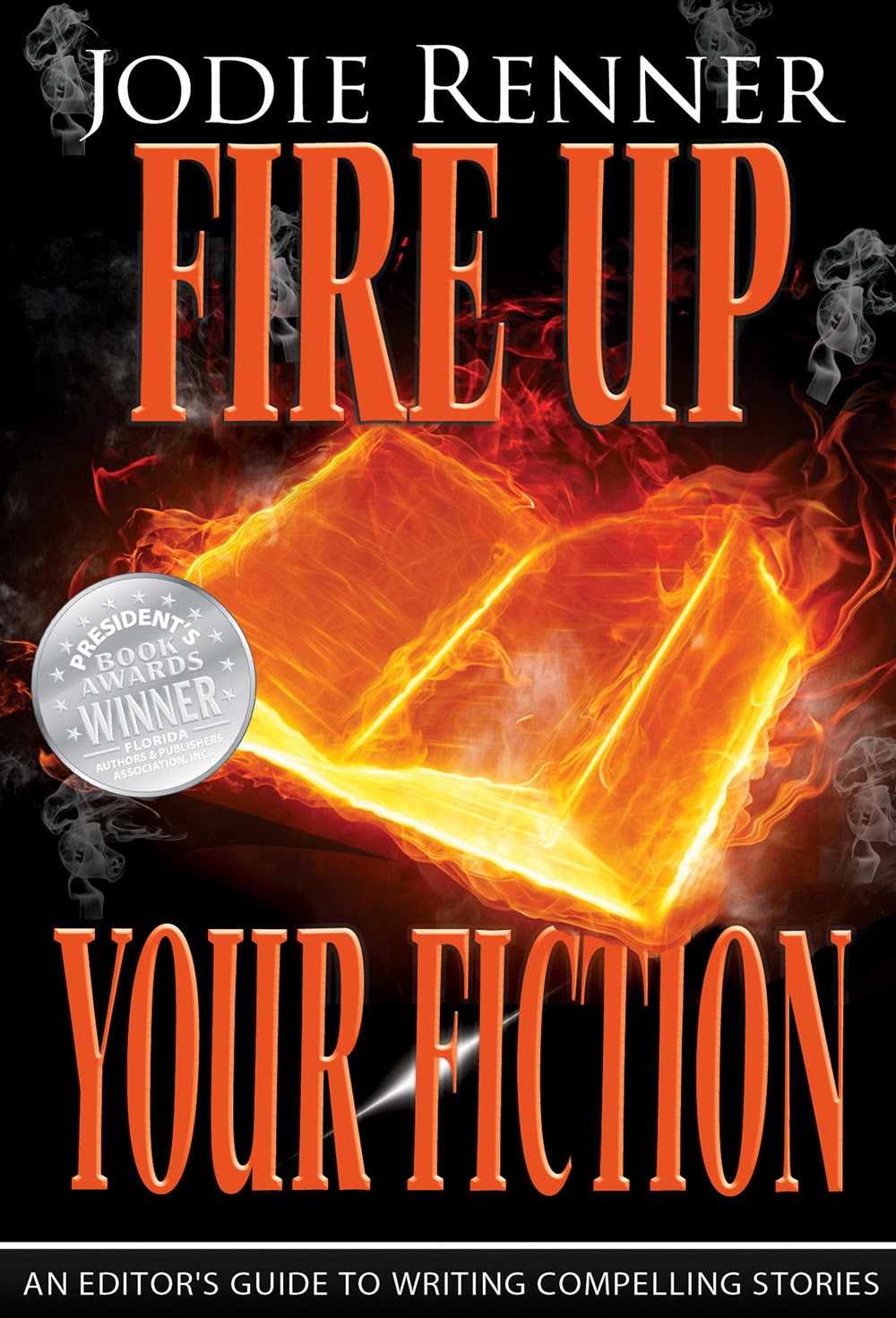
Jodie Renner, a sought-after freelance editor, has published two books to date in her series, An Editor’s Guide to Writing Compelling Fiction: Writing a Killer Thriller and Fire up Your Fiction, which has won two awards to date, and is a finalist for two more. Her third book in the series, Captivate Your Readers, will be out in fall 2014. For more info, please visit Jodie’s author website or editor website, her group blogs, The Kill Zone and Crime Fiction Collective, and find her on Facebook, Twitter, and Google+. To be the first to hear when Jodie's next book is out and to receive links to valuable, timely blog posts, sign up for her newsletter here.