Showing posts with label crime fiction. Show all posts

Friday, March 14, 2014

The Link Between Creativity and Dishonesty

by L.J. Sellers, author of provocative mysteries & thrillers

An article in Scientific American, based on research studies, concluded that "Encouraging people to think outside the box can result in greater cheating and crossing ethical boundaries can make people more creative in a subsequent task." This caught my eye because I think of myself as a creative person. A few days earlier, I read the post “18 Things Highly Creative People Do Differently” and checked yes on almost everything. So does that also make me inherently dishonest?

I don't think so, but since I write crime fiction, I had to scrutinize whether the theory applied to me.

Overall, I tend to be painfully honest. Law-abiding. Responsible. And sober. All the time! But when I was younger, I was bit more wild. So now, maybe adhering to the straight and narrow in my real life (while suppressing my wild side) leads me to enjoy writing from the perspective of a character who is the opposite. Namely, Agent Jamie Dallas.

I’m currently working on my second book in this series—featuring an undercover agent who infiltrates groups to gather evidence and break open crime rings—and it’s as fun as the first time. (Here’s a link to the cover and description.)

This young character (also something I’m not anymore) has to lie, cheat, steal files, seduce targets, party with her new peers to be accepted, sneak into places she isn’t supposed to, and put on performances to accomplish her goals. All of it is for the sake and safety of her country—but Dallas loves her work in a special way. Once I got inside her head and wrote her part the first time, I had so much fun, I knew she had to have her own series.

So maybe there’s a bit of Dallas buried inside me that needs to get out and play sometimes. Or maybe that’s why I write crime fiction. Because creativity is linked to deviant behavior, so that’s the only kind of story I know how to tell.

What do you think? Does our creativity lead to deviant behavior or does unethical activity lead to creativity? Or is the research on this subject inherently flawed?

Wednesday, November 27, 2013

Sexy on a Stick, or Broken and Flawed? How do you like them?

By Andrew E. Kaufman-Author of psychological thrillers
The tattooed, bad boy biker.
The sexy, iconic rock star.
The brooding detective with a tortured soul who always finds the killer.
Let’s face it, those characters are likeable and appealing, and they’ll always sell. It’s why we see them every day on TV, read about them in novels. If I’m going to be completely honest, I may or may not have even fantasized a time or two about being a few of them. Maybe even pondered the idea of changing my name to Chance, Shane, or Luke.
But those characters have never felt very real to me; in fact, other than their tough exteriors and chiseled jawlines, there’s not much else I remember about them.
When I sat down to create Patrick, the protagonist in my bestselling psychological thriller, The Lion, the Lamb, the Hunted (and its newly released sequel, Darkness & Shadows), I was hoping to break the hero mold. I didn’t necessarily want perfect—I wanted perfectly flawed.  I wanted a hero who was not your everyday hero.
So how did I do it? I went against the thriller grain and broke some rules.
What I ended up with was a very un-Hollywood male lead who could still be appealing. After stripping down the tough exterior you often see with typical heroes, I allowed Patrick’s emotional vulnerability to not only be blatantly exposed, but to help tell the story and drive the plot. Yes, he’s a victim of a horribly tragic and abusive childhood, but he refuses to remain that way. He’s not out to save the world—he’s desperately trying to save himself.
To further his depth and complexity, Patrick suffers from OCD. He’s a journalist obsessed with making lists, consisting of the same words over and over, page after page. His OCD is a coping tool used to survive his unthinkable childhood. Instead of experiencing his pain associated with the abuse, he instead learned to list it. The problem? What saved him then, haunts him now.
But that wasn’t enough for me. More damage, more layers, more angst. More! I gave Patrick a disease where even the slightest cut can make him bleed to death. While this makes for some great and terrifying action scenes, it’s also a powerful metaphor that runs through these books: his childhood has left him emotionally scarred and afraid of being broken open. With his blood disease, he’s as susceptible on the outside as he is on the inside.
And last, but certainly not least—because he’s never had it—Patrick wants desperately to be loved. And he wants to give love. This is his journey in life, and much like everyone else, he has to find himself first.
Typical? Well, not so much, I guess, when you consider the gold standard for some fictional heroes--but I wasn't going for the standard. I was going for flawed. I was going for vulnerable. 
I suppose it was only after I’d completed the first book, that I became a bit worried about how Patrick might be seen by readers who were hoping for a more archetypal male lead, but I write from instinct, not logic. Was it a risk? Sure, but I'm a firm believer in taking them when instincts dictate, and it seemed to have worked. But even today, I still have difficulty breaking him down and capturing his appeal.
So for balance, I looked for a female point of view. My friend and fellow author, Jessica Park, had this to say:
“Look, I’ve read about the hot, perfect, studly leads. In your books, you give us a character, Patrick, with all his raw, emotional, tortured pain. And you also give us Patrick as a hopeful, determined, insightful, and beautiful person. Female readers fall in love with him because of his willingness to examine his own damage, to tear apart his years of hurt, and to battle against the past so he can find a better future for himself. It’s in his pain, and in his fight, that we see meaningful bravery and strength. That makes for powerful, intoxicating reading. And that also makes us want to scoop up that hottie and take him home with us.”
Authors and readers:  How do you like your heroes? Tough as nails? Sexy on a stick? Metrosexual? Self-actualized? Really, there is no right or wrong, and when I think about it, maybe we actually need them all.
Happy Thanksgiving,  everyone!

Friday, October 25, 2013

Are You Getting Your Money’s Worth?

by thriller author Michael Sherer

At dinner with several authors a couple of months ago, I mentioned how disappointed I’ve been in the past few years with so-called bestselling thrillers and mysteries. These books have been filled with stories that border on outlandish and implausible inconsistencies and mistakes, with mediocre writing at best.

Lee Goldberg, one of the authors at the table, said he thought it was because so many authors are writing to a formula these days. I contend that, discounting the real crap, there are three basic types of authors getting published: 1) beautiful writers who can’t tell a story, 2) storytellers who write at an eighth-grade level, and 3) writers who tell terrific stories with beautiful prose.

John Grisham, for example, is a terrific storyteller who keeps you turning the pages, but his prose isn’t anything to write home about. Serviceable, I suppose. (Heresy, I know, but I think Stephen King is in this camp, too.) Wallace Stegner, on the other hand, paints beautiful pictures with prose, but can’t tell a story that makes sense, or at least that holds my interest.

At dinner, I rattled off some of my favorites in the third category: Gregg Hurwitz, Jeff Parker, Lisa Unger, Bob Crais, Tana French, Michael Gruber, Tim Hallinan, Jonathan Kellerman and even Michael Connelly, though his prose is more straightforward, something you’d expect from a former newspaper reporter.

Lee contends that guys like Gregg and Jeff, and Connelly until recently, haven’t broken out to as wide an audience as many “bestselling” writers for precisely that reason—because they don’t write to the formula, because their prose is too pretty. I happen to think all the writers listed above are pretty successful, but I get his point.

But my real question is whether readers are settling for less than their money entitles them to. With Kindle’s 99-cent and freebie specials, there’s a lot of very inexpensive entertainment out there. And self-publishing has opened the floodgates to content of every stripe. But there are still a lot of thrillers that will cost you $34.95 in hardcover and $12.99 in e-book format out of the gate before publishers start seriously promoting them. That’s a lot of money. At $3.99, an e-book is cheap compared to a movie or dinner out, but hardcover prices are real money.

I ran across this quote from Patrick Anderson’s book The Triumph of the Thriller on Facebook the other day. "James Patterson is possibly the best-selling writer of fiction in America today. He is also, in my view, the absolute pits, the lowest common denominator of cynical, scuzzy, assembly-line writing. If, on a bullshit scale, people like Pelecanos and Leonard rate a perfect 0, Patterson is the other extreme, a bloated, odoriferous 10. So why is he popular? Well, he keeps things not just simple but simple-minded. He writes short sentences and short chapters and deals in stereotypes. He teases his readers with soft-core sex. He telegraphs who are the good guys and who are the bad guys—a man with a scar on his face is a bad man, a girl who doesn’t wear makeup is a good girl. He panders to ignorance, laziness, and prurience."

I couldn’t agree more. But for me, Anderson’s explanation of why Patterson is so popular raises more questions than it answers. Are readers that dumb, that afflicted with attention deficit disorder they only can digest short sentences, stereotypes, and semaphore signals designating who’s who? Are readers truly ignorant, lazy and lecherous?

I’m a sensible eater, but I’ll admit to occasional junk food binges. I prefer a rich and varied diet of thriller authors like Charlie Huston, Tom Piccirrilli, J. Carson Black, Tyler Dilts, Greg Rucka, Sean Doolittle, Gillian Flynn, Marcus Sakey, Taylor Stevens, Alison Gaylin, Sean Chercover, and Laurie King in addition to those I listed above. But that doesn’t mean I don’t indulge in the candy afforded by Lee Child and Jeff Abbott. They definitely give me my money’s worth.

And, yes, my cup of tea may be your glass of hemlock. Reading is, after all, a subjective pursuit. But there’s a ton of true garbage hitting the bestseller lists these days. Is that really what readers want? Pablum written to the lowest common denominator? Are we really getting what we pay for?

Is Anderson right? Who do you read and why?

Michael W. Sherer is the author of NIGHT TIDE, the second novel in the Blake Sanders thriller series. The first in the Seattle-based series, NIGHT BLINDwas nominated for an ITW Thriller Award in 2013. His other books include the award-winning Emerson Ward mystery series, the stand-alone suspense novel, ISLAND LIFE and the Tess Barrett YA thriller series. Please visit him at www.michaelwsherer.com or you can follow him on Facebook at www.facebook.com/thrillerauthor and on Twitter @MysteryNovelist.

Friday, July 19, 2013

When Bad Things Turn Out Well

by L.J. Sellers, author of provocative mysteries & thrillers

We discovered water in our bathroom wall recently, and the damage was extensive. My initial reactions were to first blame myself: How could I let this happen? Next, to be stressed about the time and cost of the repair.

Fortunately, my hairdresser (love this woman!) reminded me that insurance pays for things like this. The transition will be inconvenient and annoying, but in the end, the bathroom will be essentially remodeled for about the price of the deductible. A nice outcome.

I'm trying to keep that in mind as I go through a similar situation in my writing career. With my latest book, a standalone thriller, my editor wants me to make a major plot change, one that I disagree with. My initial reactions were the same as they were for the water problem—a sense of failure, then stress about a negative outcome.

But the more I think about it, the more I realize this could turn well. My beta readers (including a professional) love the story the way it is, and I'm not inclined to cut a plot element that ratchets up the tension on a global level. So, as much as I love publishing with Thomas & Mercer, I'm going indie with this one.

Even though I call it a standalone, the book features Agent Dallas—introduced in Crimes of Memory (Jackson #8)—and will launch a new series. Although publishing with Amazon has been great for my career, it's not a bad idea to diversify and keep some control of my work.

Additionally, I'll be able to bring the book to market sooner on my own, and I'll earn a higher royalty. So this could turn out like the bathroom situation—more benefits than drawbacks.

In the meantime, I have to get my head back into indie mode and start thinking about marketing again. This transition will also be a lot of work and at times frustrating, but ideas are coming to me, and I think my wonderful readers will support me. 

What do you think? Am I crazy for sticking with the story instead of the publisher? If you're one of my readers, will you try the new book?

Friday, June 7, 2013

Do You Stand Alone?


by L.J. Sellers, author of provocative mysteries & thrillers

Sandra Parshall, who happens to be a terrific blogger, posted yesterday about standalone suspense fiction and how she likes it better than crime fiction series, but that few authors are writing it. I'm not sure that's technically true. Many of us are writing it, but often, one of two things happen. Either the standalone doesn't sell as well as our series books, or it's so popular that readers want more, and it ends up launching a new series.

There are exceptions of course. Gillian Flynn writes popular standalone thrillers and grows her readership with each one. And some series writers have expanded their readerships by writing standalone thrillers (Laura LippmanHarlan Coben). That's what I hope to do with my new thriller.

Yet, I love the character, and I know I'll bring her back for more stories. Her setup as an FBI agent who specializes in undercover work is perfect for a series that has a lot of flexibility.

I introduced Agent Dallas in Jackson #8, Crimes of Memory (which will release Oct. 15!). I had so much fun writing her part that I knew she needed her own story. And I had an idea that I really wanted to write about and she was perfect for it. My beta readers loved the story, and I'm still waiting to see if my publisher does too.

More important though will be if readers like it. Especially new readers. I know some of my Jackson fans will pass, just because it's not a Jackson story. But I hope enough new readers will be interested in the novel to justify the five months I put into researching and writing it.

Here's a quick description: Agent Dallas goes undercover to find a missing woman who is likely being held captive in an isolated prepper community. What she finds is a lot more terrifying.

Readers: Do you read the standalones of your favorite series authors?

Writers: Do you write series, standalones or both? And what is your experience?

Friday, March 15, 2013

Killing Off a Character

by L.J. Sellers, author of provocative mysteries & thrillers

I killed my first recurring character recently, and it still haunts me. She wasn't particularly popular, but the manner of her death was shocking. The ending made my beta readers cry for my protagonist, but they said they loved it. And so did my publisher. So I crossed my fingers and let it go to press.

Still, I knew it was a risk. Readers complain loudly when writers kill characters. They post negative reviews and ratings and often claim they'll never read another book by the author. Some even follow through.

Television writers kill characters even more often than novelists do. Have you seen the third season of Downton Abbey? Viewers were infuriated. Or the last season of Grey's Anatomy? Ouch!

Why do authors do it? For several creative reasons and possibly one egocentric rationale. First, the self-centered reason. Literary experts say if you're not willing to kill a character, then you're not a real writer. They say you lack the courage to be realistic and daring. So killing a character is a challenge that many writers feel compelled to experience.

But that's not why I did it. If a character's full story arc has been told, and there is nothing left for that person to do, then killing him or her is essential for the series. It's only fair to readers to cut the dead weight and allow the story arc of other characters to grow and take new paths. Sometimes a death at the end of one story is the best way to set up a new story that begins with an emotional punch. Also, the action in the climax is often so intense that if no one dies, the story doesn’t feel realistic.

Another reason—which TV writers cite as their main motivation—is that killing a character creates uncertainty. Once readers/viewers realize that anyone could die, that quiet dread ratchets up the suspense.

Which is why readers and viewers keep coming back to a series even after someone they love has been dispatched. Many fans will rant and rave, but eventually they'll accept the development and find themselves ready for more. Only now, their anticipation will be greater than ever.

This pattern is probably truer (safer) for television than novels. Book lovers get more attached to their mainstays, and therefore more upset by unexpected deaths. When you kill a recurring fictional character, you will lose some readers forever.

What is the payoff for novelists? The satisfaction of telling the story the way they envision it. The freedom to take the series or protagonist in a new direction. Maybe even more important—the rush of taking a risk and the confidence that comes with surviving it.

So in Rules of Crime, book seven of the Detective Jackson series, I finally killed a character and I made my protagonist suffer for it. So far, most of my faithful readers have supported—even loved—the decision. But not everyone. I just hope the few who are disappointed will come back to find out what happens next. Book eight is written, and I've made the development pay off in an a rewarding way.

What about you? Have you abandoned an author for knocking off a favorite character? Do you give TV writers more slack than novelists? Tell me what you think.

Friday, February 1, 2013

Pulling Off a Parallel Plot

by L.J. Sellers, author of provocative mysteries & thrillers

Complex plots keep readers guessing and turning the pages to see how it all comes together. But as much as people like to be surprised, they don't want to be confused, and it's often a fine line between the two.

As a crime fiction novelist, I've often used parallel plot structures to tell a complex story from multiple points of view, and sometimes even from different time periods. But readers rarely—if ever— complain about being confused by my stories. Maybe I've just been lucky so far, but I also stick to a few simple rules to keep everything straightforward and satisfying.

Time and dateline: I label my chapter openings with the date and time. If a chapter/subplot jumps back to a different time period, I label it like this: Six months earlier. By doing that, I catch readers' attention and present the information in a clear manner.

My stories also take place in a short time span, usually less than a week, so two characters (detectives) often experience different things in the same time frame. That means chapters with a new character perspective (POV) have to start hours earlier than the previous chapter ended. Readers prefer starting each character's day from the beginning rather than jumping back and forth between characters in real time, which can be confusing and doesn’t allow for deep character development. The exception to this is the climax, where it's important show events as they occur in real time for maximum tension.

Show the overlap. When parallel stories seem to have completely different crimes and/or characters, the driving question for readers is: How are these events connected? But if the two subplots never intersect and just suddenly mash together at the end, readers will be skeptical and maybe even feel cheated. So to keep it realistic and smooth, I show an occasional connection throughout the novel—a person who has links to both crimes or even a parallel theme.

In the first Jackson story, The Sex Club, the connection between the parallel plots was obvious because of several overlapping characters, but still a mystery. In my latest Jackson story, Rules of Crime, the connections are subtle—a shared venue/background and characters with similar traits. Some readers may even miss those parallels. But once the conclusion is revealed, they'll be able to look back and see that I wove them together from the beginning.

Keep it real. Sometimes coincidence can be the catalyst for the whole story, but I don't rely on it for my resolutions. Parallel plots should be naturally intertwined through characters and/or motivations. Contrivance or coincidence will leave readers shaking their heads.

Also, in real life, few criminals confess everything to the police in a tidy wrap-up the way they do on TV. This can be problematic if the subplot connections are events that happened in the past or events the reader has no way of being privy to. In these situations, I sometimes use the culprit's POV to show their motivation or past actions, so that readers know the whole story even if the police don’t. It's more realistic than having the killer make a full confession with all the details. And sometimes, my antagonist will share just enough information in a final interrogation to allow readers to draw their own conclusions. In both cases, it's realistic and leaves readers satisfied.

These examples refer to crime fiction, but I think they can be applied to complex parallel stories in almost any genre.

What do you think? Readers: Do you enjoy complex or parallel plots? Writers: How do you make it work?

Wednesday, January 2, 2013

With all the crime.....


By Jenny Hilborne, Author of mysteries and thrillers

I've noticed a lot of recent discussion about fictional crime compared to real life crime, with plenty of focus on the negative aspects of fictional crime, especially in the face of the horrific shooting events in the US. The fictional violence and brutality sometimes bothers me, too, if I think about it too much, so I wanted to concentrate for a few minutes on the positive, fun aspects of fictional crime.  

Mystery writers must consider many things in their stories: plot, subplot, motive, setting, logic, alibi, clues, evidence, witnesses, and conclusion, with explanation. It must all make sense. Different types of mysteries include a variation of these elements: a cozy is a more peaceful mystery with lots of clues, less action, and less danger to the main character; a hard-boiled mystery includes a lot of action and rough realism; procedurals draw the reader's attention to the rules of law enforcement; an amateur sleuth stumbles into the mystery by accident and helps the detective solve the crime.

All good mysteries contain secrets, riddles, and clues to solve the puzzle. What makes a mystery or a thriller spectacular, for me anyway, is the element of surprise, the perplexity of the plot, the probing questions that draw me deep into the story, and the fact it is fiction and not real life - a world I can visit, without participating in any of the crimes, except trying to catch the killer. After watching a couple of Agatha Christie episodes last week, I realized I mostly enjoy the red herring. It's a mind game using clues to capture and evade, rather than coincidence. The villain matches wits with the detective, the reader matches wits with the author to crack the case. The reader wants to work out the author's plot and the author tries to prevent it, until he/she is ready for the big reveal. We are testing each other.

Red herrings are the false clues that throw off the investigator, increase the challenge and make the mystery so much fun. Skillful mystery writers like Agathie Christie make the guilty appear innocent, turn the innocent into suspects and do so convincingly, sending us looking the wrong way. It's like finding our way out of a maze and we learn from our mistakes, sharpening our skills each time, both as readers and writers. 

Another spectacular part of the fictional mystery is the shock - finding out the guilty person is the one we trusted, realizing the flaws in our own judgement. This is another opportunity to learn about ourselves and improve our analytical skills.

Fictional mysteries bring readers together to discuss, imagine, compare, and to recommend. I hang out in various online mystery groups to share my thoughts and look for suggested great reads. Fictional mysteries become more and more sophisticated and the challenges get harder. Techno thrillers give us a glimpse into a possible future world and stretch our imaginations.

To finish, here are a couple of my favorite mystery reads from 2012:

Chalk Valley by D.L. Johnstone: Excellent suspense told from several viewpoints.
The Dark Monk by Oliver Potzsch: Well plotted with a maze of riddles and clues
Bleed For Me by Michael Robotham: harrowing story of corruption, perversion, abuse of power, and murder.

Friday, December 21, 2012

When Cops Are Crazy

by L.J. Sellers, author of provocative mysteries & thrillers

Two recent new stories stuck in my brain, and I filed them both away for potential novel ideas. But I know I'll never use them because when the truth is stranger than fiction, you can't use it as fiction. Readers just won't buy it. But it's still fascinating, so I'll share these freaky cases involving police officers.

This first one happened in my home state of Oregon. Female police sergeant Lynne Benton had a longtime partner, a beautician named Deborah Higbee Benton. After many years together, Lynne underwent a gender change and became Lynn Edward Benton. The gender change caused problems in their relationship, but once they could legally get married, they did. Within a year, Lynn had lost his/her job as a police officer and Debbie had been murdered.

The case is still pending, but charges had been filed and detectives believe that Lynn hired Susan Campbell to murder Debbie. Susan Campbell has pleaded guilty, and in addition, her son, Jason Jay Jaynes, has been charged with murder. Debbie, who was horribly beaten to death, didn't do down easy, so Susan allegedly called her son to finish the job. All three—the transgendered cop, the hit woman he hired, and her son—will likely be convicted of murder.

Speculation is that Debbie wanted out of the relationship after her partner switched from female to male, and Lynn decided to kill her instead. My personal speculation is that Lynn was taking way too many male hormones.

The other case is just as strange. Gilberto Valle, a 28-year-old officer with the New York Police Department, created a document called a blueprint for “Abducting and Cooking.” His estranged wife reported the oddities she'd seen on his computer, the FBI got a warrant to search, and they uncovered several plots to kidnap, rape, torture, cook, and eat women. Yes, you read that correctly.

“I was thinking of tying her body onto some kind of apparatus,” Valle wrote to a co-conspirator in one email recovered by law enforcement. “Cook her over a low heat, keep her alive as long as possible.”

The investigators discovered files for more than 100 women on Valle's computer, with details such as the woman’s date of birth, height, weight, and bra size. Valle also made note of certain materials, such as chloroform and rope. Some of the women were his classmates from high school, and at least ten women confirmed that they knew Valle personally. A few had even dated him.

As yet, they have no evidence the officer acted on any of his plans... but I know I would feel better if they locked him away.

What real life crimes have you read about that are too strange for fiction?

PS: If you're a fan of my Detective Jackson novels, you can request an advanced review e-book copy of Rules of Crime at Net Galley.

Saturday, December 1, 2012

Step Away From the Desk


 Guest post by Kelly Miller, crime fiction novelist

I’m sure you’ll all agree technology has made the writer’s life easier. No more trips to the library, just Google it. No more visits to the courthouse, instead check records online. Now that we have Google Earth is there a need to travel to the corner of Cherry & Main when you can simply power up the computer and visit electronically? But this begs the question, have we become too dependent on technology?

It’s tempting to lean on our computer crutch. A writer has so few minutes free in the day. If we’re not writing our next novel, we’re endlessly blogging, tweeting, and facebooking. So I can understand our dependence on virtual travel. But I say, “Step away from the desk!” 

If you simply rely on a picture on a computer screen, you’ll miss out on the nuances of a location, the flavor of a city. Researching for my debut novel, Dead Like Me, I set up a private three-hour tour of the Tampa Police headquarters. It was the best thing I could have ever done for my novel. I like to keep my stories as factual as possible so I wanted to record everything. Like the fact that the homicide department is on the eighth floor and how the precinct has a nondescript smell. Unless of course, you’re on the fourth floor when seized marijuana plants are drying out. 

As a crime fiction writer, police anecdotes and rookie mistake stories are golden. When I toured the homicide department, I discovered the guys had played a practical joke on one of the detectives. They turned his desk into a boat, attaching a steering wheel to the end of the desk and PVC piping to the top creating a bimini. A steel cleat was even mounted right in the middle of his desk. Of course this was too good to pass up, so I included it in my novel. These are all things I never would have found out through interviews or sitting behind my computer. 

How about you? Do you rely heavily on your computer for research, or do you get out from behind your desk and travel, soaking up the local flavor of a location? Or maybe you use a combination of the two approaches?


Kelly Miller’s first novel, Dead Like Me, debuted November 29. To purchase a copy, visit www.blackrosewritingbooks.com. You can learn more about Kelly by visiting her website at www.kellymillerauthor.com or her blog at http://apps.kellymillerauthor.com/blog.

Monday, November 12, 2012

Red Herrings Stink

A guest post by Nancy Springer.

I’m not sure I really am a mystery writer. Up until I received my first Edgar, I thought I was a generic novelist interested in crime. I don’t plot, I don’t murder a character before chapter three, and I don’t plant red herrings. As far as I’m concerned, the less my fiction resembles a fox hunt, the better.

Fox hunt?


Well, you know how we refer to traditional mystery writing: Sleuth hounds sniffing out the trail of the criminal, but led astray by red herrings. That’s fox hunt imagery. In many a jolly good British fox hunt, a prankster dragged a red herring across the fields, because the odor of the smoked fish was so strong it would almost certainly throw the hounds off the track.

Contemplating overdressed people on expensive horses galloping behind a pack of dogs, Oscar Wilde dubbed fox hunting “the unspeakable in full pursuit of the inedible,” thus begging the question: why? Why kill a fox? I have often wondered similarly, why the first body, the second body, and the third body?

I prefer to write crime fiction that is corpse-optional, about missing persons, abduction, stalkers, family secrets, bad guys poaching endangered animals or other environmental crimes. There are many non-cadaverous alternatives to murder, and they occur to me naturally enough when I try to write a mystery novel, as opposed to a fox hunt. I consider plotty plots with red herrings to be egregiously deceptive. Instead, I try for an original, character-driven work, a well-crafted narrative with no need for artifice. I say fences, foxes, red fish, forget it.

Why? Because a fox hunt is essentially an old-fashioned, frivolous pursuit, and so is the contrived murder mystery. Many of us, self included, enjoy a good the-butler-did-it, but today’s world, crime is no game. Nor, I think, do we want it to be. In today’s atmosphere of bad news, domestic abuse, drug trafficking, violence in the schools, and worse, I think there’s a need to acknowledge that villainy is not a cozy, orchestrated logic problem; evil is here, now, and it is messy. I think we need to write honest no-tricks mystery. Red herrings stink.


Nancy Springer has written fifty novels for adults, young adults and children, in genres that include mythic fantasy, contemporary fiction, magical realism, horror, and mystery -- although she did not realize she wrote mystery until she won the Edgar Allan Poe Award from the Mystery Writers of America two years in succession. Dark Lie is her first venture into adult suspense.
Born in New Jersey, Nancy Springer lived for many decades near Gettysburg, Pennsylvania, of Civil War fame, raising two children, writing, riding horseback, fishing, and birdwatching. In 2007 she surprised her friends and herself by moving with her second husband to an isolated area of the Florida panhandle, where the birdwatching is spectacular and where, when fishing, she occasionally catches an alligator.


A review of Dark Lie is posted on Stuff and Nonsense today.  I'm also giving away a copy of Dark Lie, courtesy of The Penguin Group.  Please stop by and comment to enter!

Sunday, October 21, 2012

SOME GREAT RESOURCES FOR CRIME FICTION WRITERS & READERS

by Jodie Renner
New England Crime Bake
I'm compiling a list of resources for crime fiction writers and readers, and I'd love your help with it! So please, if you have any organizations, conferences, blogs, or other resources to add, let me know in the comments at the end and I'll add them.

Part I – Organizations, Conferences, and Conventions in North America and Great Britain, and a short list of good Blogs

ORGANIZATIONS:

Click on the organization’s name to go to their website.

International Thriller Writers - an honorary society of authors who write books broadly classified as “thrillers.” This would include murder mystery, detective, suspense, horror, supernatural, action, espionage, true crime, war, and action-adventure. ITW brings together almost 1000 writers, readers, publishers, editors and agents at its annual conference, ThrillerFest, as well as at CraftFest, a writing workshop program, and AgentFest, where aspiring authors can meet and pitch top literary agents.

Mystery Writers of America - MWA, founded in 1945, is the premier organization for mystery and crime writers, professionals allied to the crime writing field, aspiring crime writers, and folks who just love to read crime fiction. Each spring, they present the prestigious Edgar® Awards. MWA also helps to rebuild libraries and offers numerous symposiums and events for both authors and fans. 

Sisters in Crime – SinC has 3600 members in 48 chapters world-wide, offering networking, advice and support to mystery authors. Members are authors, readers, publishers, agents, booksellers and librarians who love the mystery genre and want to support women who write mysteries. Membership is also open to men.

Crime Writers of Canada – CWC is a national association for Canadian mystery and crime writers, associated professionals, and others with a serious interest in Canadian crime writing. Promotes Canadian crime writing. Newsletter, information on authors, awards, and links. The CWC has sponsored Canada’s Arthur Ellis Awards for Crime and Mystery Writing since 1984.

Crime Writers of Great Britain - A professional body which sets out to represent writers of crime fiction and non-fiction. The CWA has played a major role both in discovering and supporting the careers of many of Britain’s finest writers, including PD James, Ian Rankin, Frederick Forsyth, Ruth Rendell, Val McDermid and Alexander McCall Smith. Presents the annual prestigious CWA Dagger Awards to recognize quality in today’s crime and thriller fiction writing.
 

CONFERENCES, CONVENTIONS, & WORKSHOPS FOR CRIME WRITERS:
 
Click on the name to go to the website. Also see list of Writers’ Conferences and Book Festivals.

THRILLERFEST and CRAFTFEST – International Thriller Writers annual conference, New York, NY. July 10-13, 2013. A four-day celebration of suspense-thriller novels, the authors who write them, and the fans who read them. Includes Craftfest, the first day and a half, crammed with excellent craft workshops to choose from presented by bestselling authors, and Agentfest, a half-day of pitching to as many agents as you can cram in. Thrillerfest, the last two days, features excellent panel discussions on various topics.

BOUCHERCON Crime Fiction Convention – world mystery convention, open to anyone; a place for fans, authors and professionals to gather and celebrate their love of the mystery genre. Includes book-signings, panels, discussions, and interviews with authors and people from the mystery community covering all parts of the genre. Anthony Awards, named after Anthony Boucher, presented at the convention. Latest one: Oct. 4-7, 2012, Cleveland, Ohio.

LOVE IS MURDER MYSTERY WRITERS CONFERENCE, Chicago, IL. Feb. 1-3, 2013. The Love is Murder Mystery Authors, Readers and Fans Con is always Super Bowl weekend, at the Intercontinental O'Hare Hotel, just outside of Chicago. Draws more than 300 writers and readers from the U.S., Canada, and overseas. Features panel discussions, author signings, demonstrations, Lovey awards banquet, entertainment, and opportunities to meet mystery authors and network with other readers and fans.

WRITERS’ POLICE ACADEMY, Jamestown, NC. The Writers’ Police Academy offers the most hands-on, interactive and educational experience writers can find to enhance their understanding of all aspects of law enforcement and forensics. This is a one of a kind event, featuring real police, fire, and EMS training at an actual police academy. Top instructors and experts! Most recent one: Sept. 20-23, 2012

THE NEW ENGLAND CRIME BAKE Conference, Dedham, Mass, just outside Boston. Nov. 9-11, 2012 - an annual conference celebrating the work of New England crime fiction and nonfiction authors. Features panels, seminars, and interviews with authors, literary agents, and experts in forensics and other fields related to crime writing, as well as classes on writing craft, manuscript critiques, and book signing events. 

CAPE FEAR CRIME FESTIVAL Feb. 1-2, 2013 – New Hanover Library, Wilmington, NC.
The festival is an intimate gathering for writers to learn about the craft of writing and promotion with other writing professionals.

LEFT COAST CRIME MYSTERY CONVENTION - March 21-24, 2013 - Colorado Springs, CO. LEFT COAST CRIME is an annual mystery convention sponsored by mystery fans, for mystery fans. It is held during the first quarter of the calendar year in Western North America, as defined by the Mountain Time Zone and all time zones westward to Hawaii.

MALICE DOMESTIC, annual traditional mystery fan convention, in Bethesda, MD. May 3-5, 2013. Malice Domestic is an annual "fun fan" convention in metropolitan Washington, D.C., saluting the traditional mystery—books best typified by the works of Agatha Christie. The genre is loosely defined as mysteries which contain no explicit sex or excessive gore or violence.

CRIMEFEST, Bristol, UK – First organised in June 2008, CrimeFest has become one of the most popular dates in the crime fiction calendar. The annual convention draws top crime novelists, readers, editors, publishers and reviewers from around the world and gives delegates the opportunity to celebrate the genre in an informal atmosphere. Includes author panels, crime writing workshops, a pitch-an-agent strand, etc. May 30-June 1, 2013, Bristol.

PUBLIC SAFETY WRITERS CONFERENCE, Las Vegas, Nevada. Open to those writing fiction or nonfiction about or for any public safety field. Conference speakers include a coroner, fire fighters, police officers, and others in the writing field. July 11-14, 2013


A SHORT LIST OF GOOD BLOGS FOR CRIME FICTION WRITERS 

Click on the blog name below.  If you have any more suggestions for blogs aimed at writers and readers of thrillers, mysteries, and other crime fiction, please let me know.

~ Crime Fiction Collective

~ The Kill Zone

~ Mystery Writing is Murder           

~ Murderati

~ The Writer’s Forensics Blog    

~ The Thrill Begins

~ Suspense Magazine’s blog

~ Sisters in Crime

~ Poe’s Deadly Daughters


Crime fiction authors and readers: Do you have any crime fiction organizations, writers’ conferences, fan conventions, or blogs to add to this list? If so, please use the comment boxes below and I’ll add them. Thanks a lot!


Jodie Renner, a freelance fiction editor specializing in thrillers and other fast-paced fiction, has published two books to date in her series, An Editor’s Guide to Writing Compelling Fiction: WRITING A KILLER THRILLER and STYLE THAT SIZZLES & PACING FOR POWER (Silver Medal winner in the FAPA Book Awards, 2013). Both titles are available in e-book and paperback. For more info, please visit Jodie’s author website or editor website, or find her on Facebook or Twitter.


Friday, October 12, 2012

Bouchercon 2012

by L.J. Sellers, author of provocative mysteries & thrillers  
Bouchercon was terrific for me this year. I finally felt like a real author with a wide reader base and respect from other authors, even though the conference programmer didn’t offer me a panel until I politely pointed out that I met all the criteria. But in the long run, it didn’t matter.

My highlight this year was having dinner with the Thomas & Mercer team and getting to know Andrew Bartlett, the acquisitions editor. At that dinner, I also met Blake Crouch, Sean Chercover, and Dana Cameron, and walked back in the rain with with Tom Shreck, whom I’ve known since we were both with the same small press. (Blake and Tom are in a lower photo.)

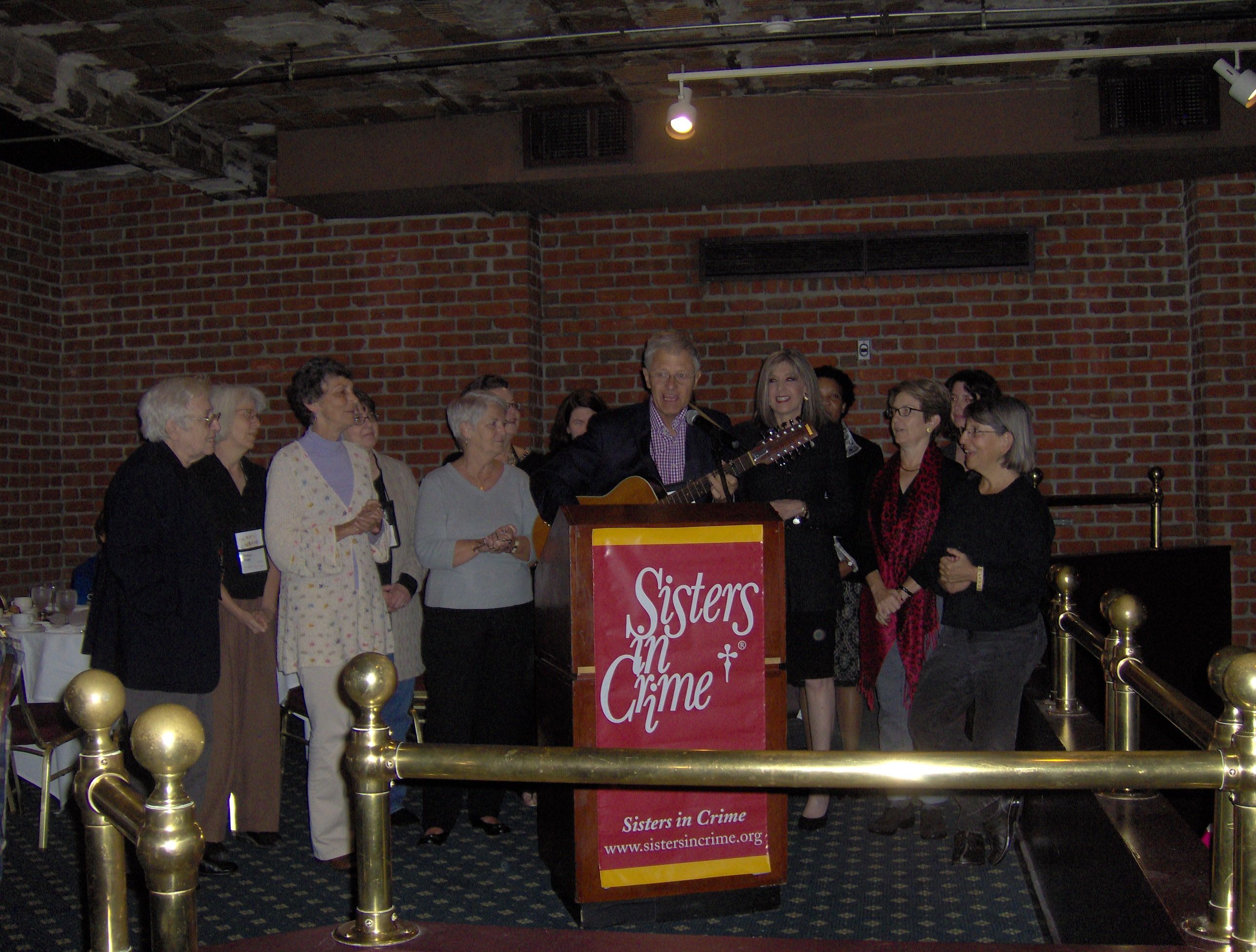
But let me back up. I started Friday with a Sisters in Crime breakfast, complete with singing a chorus of “You show me your gun, I’ll show you mine.” Then I attended a panel called Old Friends, New Friends, nicely moderated by Jen Forbus, followed by Eve of Destruction—with authors Sophie Littlefield, Deborah Coonts, Tracy Kiely, and Rochelle Staab—who talked about their kickass female characters.

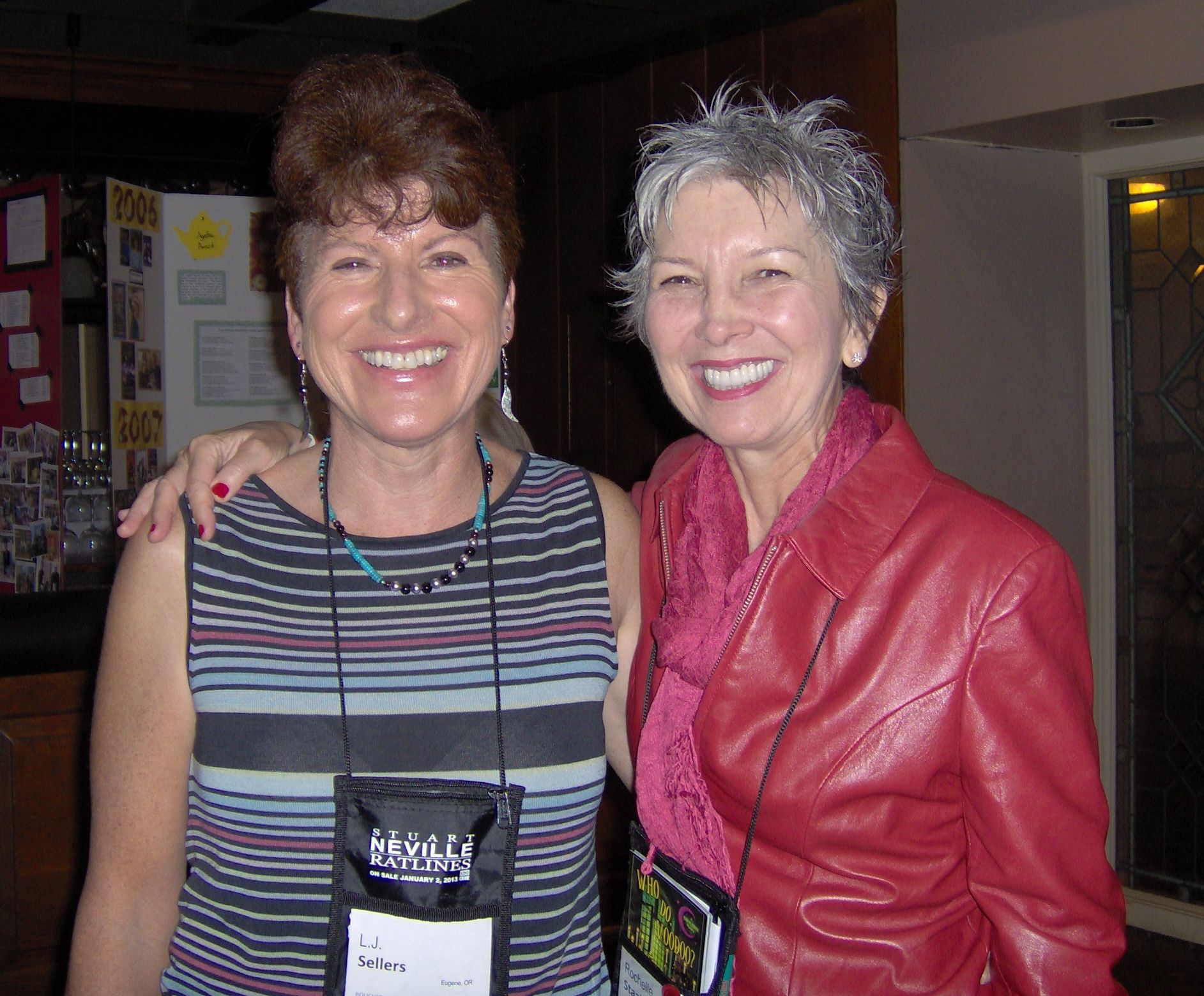
I spent a lot of time with Rochelle, who I’d Skyped with earlier in the year for a Big Thrill feature. She’s just as dynamic in person. (Bottom photo in gorgeous red leather.) A little later I met up with longtime online friend Debbi Mack for the first time—lovely woman—and had lunch with her and fellow panelist, Conda Douglas, and new author friend, Molly Cox Bryan. Friday afternoon, I attended Men Are From Mars, Women Are From Venus, a terrific panel where they talked about writing from the opposite gender’s perspective. The room was packed to see Elizabeth George, Val McDemid, Alan Jacobson, Tom Shreck, and another friend, Alexandra Sokoloff. The moderator, Daniel Palmer did a great job of keeping it lively.

Saturday was a day of conversations. I chatted with readers and authors all day—including Zoe Sharp, Julie Hyzy, Claudia Whitsitt, and Annette Dashofy —and had lunch with my terrific roommate and author Terry Shames (top photo), along with Keith Raffel, Boyd Morison (and his wife Randi) Tracy Kiely, and another delightful author whose name escapes me. By that point, I’d met and chatted with so many people, it was hard to mentally keep everyone straight. We talked shop, but also veered off into other stimulating subjects.

Still, that evening at the awards ceremony, I met more authors for the first time. Edgar nominee Darrell James was charming, and so was Kathy Wiley and new author Anne Cleeland. I went to dinner with Darrell James and a female author named Darrell who writes under the name Avery Aames, as well as Rochelle, Terry, Dana Cameron, Roberta Isleb, and another woman I should remember. I also chatted with numerous authors in the bar that evening, staying up late to connect with as many people as possible.

That’s the problem with blogs like this. I can’t possibly mention everyone I talked even if I could remember all their names. So if I left you out, please don’t be offended, and feel free to comment and remind me! And I have to mention that I chatted with Stan and Lucinda Surber who talked me into being a chair for Left Coast Crime 2015 in Portland. It'll be fantastic, so put it on your calendar.

The best panel I attended was on Sunday morning and called Red Herrings. Moderator Keith Raffel (a great guy!) was sharp and funny, despite a late night in the lounge, and the panelists—Beth Groundwater, Pennie Ross, D.M. Pirrone, and Melodie Campbell—all kept up with him.

Afterward while waiting to leave, I chatted with agent Janet Reid, who did her best to convince me that personal one-to-one emails are worthwhile, even with a thousand-name email list, and I know in my heart she's right, even though the task would be overwhelming.


And I shared a cab to the airport with Gigi Pandian, an delightful author I shared a shuttle with at B-con 2010. We both seem to fly home to the west coast at the same time I also talked with people on all of my flights coming and going, two of whom have already emailed me, hoping to stay in touch. I wish I had total recall for all the wonderful people I’ve met.

If you attended B-con, please share one of your moments.

Thursday, October 4, 2012

SAFECOP – a New Weapon in Tampa’s Arsenal

Guest post by Kelly Miller
The crime fighters in our novels don’t rely on Ouija boards to capture the bad guys. They use the latest technology available. If you write crime fiction, it’s imperative you familiarize yourself with the systems police departments across the country use.

When the Republican National Convention came to Tampa, Florida, last month, the Tampa Police Department was thrust into the national spotlight. Chief Jane Castor and her officers performed exceptionally well under the stress of picketers and two weeks of twelve-hour shifts. There were even Tampa residents interviewed on the local news, complaining how quiet downtown was during the RNC. If that was the worst criticism of the week, I’d say the TPD exceeded expectations.

One benefit of the convention was the purchase of a $400,000 software upgrade from Congressional money set aside for convention security. This technology allows Tampa officers to continuously scan updated maps for crime trends. When police respond to a crime scene, they enter the information collected into the system and Tampa maps are updated instantaneously. This software also allows officers access to maps showing career criminals, sexual predators, and juvenile offenders living in a specific area.

In the past, if the TPD wanted to send out a BOLO (Be on the Look Out), it could take several hours or even days for officers to receive the information. Now alerts happen in real time. Investigators can send out these bulletins using the new software as well as post photos and videos.

Shortly after the RNC, the bay area got to see this new software in action when a burglary suspect was arrested. Reportedly a man broke into an office building, ransacked the place, and stole cash and audiovisual equipment. Burglary cases often take at least a few days to solve, if solved at all. But this suspect was arrested in only two hours. Police checked the burglarized company’s surveillance video and found an image of the suspect. An officer used a cellphone camera to take a picture of the man in the video. Then the photo and a description of the suspect were entered into the new system and it quickly lead to his capture.


Kelly Miller’s first novel, Dead Like Me (due out November 29), is set in Tampa, Florida where she lives. This technology isn’t something her detectives use, but the third book in the Kate Springer series will be set during this time period—September 2012. Kelly is hoping the backdrop of the RNC and new technology like SAFECOP will add extra flavor to the story. Please visit Kelly's website and her blog.

Monday, September 10, 2012

Forensic Psychologists in Fiction

Guest post by Stacy Green

Forensic psychologists aren’t profilers.                     

According to the forensic psychologist I recently interviewed, forensic psychologists as profilers is the biggest misconception the general public has of their profession.

These people are essential to our legal system. They make crucial decisions about offenders every day, but are usually grossly misrepresented in both fiction and television. I’ve spent several weeks researching forensic psychology for a trilogy I’m working on, and I wanted to share some of what I’ve learned with the readers of Crime Fiction Collective.

Forensic psychologists don’t visit crime scenes or consult with detectives in search of a serial killer. They work within the court system, and in most states, they have two primary functions: to ascertain if a defendant was insane when he/she committed the crime, and if the offender is competent to stand trial. Their testimony is vital in deciding how a criminal will be tried, and if deemed incompetent to stand trial, they will advise a course of treatment so the offender can recover to competency. 

So what’s the process? Once a forensic psychologist is contacted by the judge or an attorney, they collect all collateral data pertaining to the case: previous interviews, crime scene photos, police video and reports, etc. In other words, a pile of paperwork big enough to make the eyes bleed. But it’s a key part of their process. 

Then it’s time to talk to the offender. Depending on the age and type of crime, the interview consists of risk assessment and various psychological tests. One of the biggest problems forensic psychologists have is defendants who malinger – the psychological term for faking insanity. 

The McNaughton Rule is the highest standard for determining the insanity plea, and the vast majority of defendants don’t qualify. An individual must be so deeply psychotic they truly don’t know what they did was wrong, and that’s rare. 

The three types of most skilled malingers are those who have taken hallucinogens in the past, ex-cons who’ve been to prison and observed mental illness first-hand, and individuals with genuine mental illness, such as schizophrenics taking their meds. 

Experts know true mentally disturbed people don’t jump in and share information about their psychoses. It’s often hard to get them to engage and even more difficult to get them to discuss what’s going on in their heads. Fakers, on the other hand, love to talk about the voices in their heads and the various conspiracy theories they “believe” in. 

Fortunately, a forensic psychologist can rely on more than just gut instinct and observation to figure out who’s malingering. They can turn to the offender’s prior records. Is there a history of mental problems? Have other professionals suspected malingering? By combing through the paperwork, a forensic psychologist can get a pretty good idea of what’s going on. 

Structured testing also helps. There are questions designed to trick the fakers, and my favorite is: We only hear voices in one ear – do you hear voices in your left or right ear? Of course this isn’t true, but the malingerer doesn’t know that. The ones who are faking pick an ear and give themselves away.

So what can we take from this? Forensic psychologists aren’t profilers. They are soldiers, working diligently in the trenches to sort out the bad from the worse and making sure the offender gets the treatment and/or punishment they need. 

As Indie writers, we’re under a microscope, and creating realistic portrayals of popular professions will go a long way in gaining credibility. 

Writers, what do you think? Are mental health professionals and law enforcement often misrepresented in fiction? What are the biggest misconceptions you see?


Stacy Green has degrees in sociology and journalism and uses her fascination of the criminal mind to explore true crime on her popular Thriller Thursday posts at her blog, Turning the Page. When she's not writing, she spends her time with her precocious daughter and supportive husband.

Stacy's debut suspense novel, INTO THE DARK, releases from MuseItUp Publishing on November 30th.

INTO THE DARK: 

He sees her when she's sleeping. He knows when she's awake. Her life he’s determined to take. Featuring a heroine on the edge of disaster, a tormented villain, and Las Vegas’s infamous storm drains, Into the Dark mixes suspense with a dash of romance.

Stacy's blog, www.stacygreenauthor.com
Twitter: @StacyGreen26
Facebook: Stacy Green, Author
Website: www.stacygreen.net

Friday, July 13, 2012

7 Great Websites for Publishing Info

by L.J. Sellers, author of provocative mysteries & thrillers

I hear from writers all the time wanting to know about resources and how I keep up with everything. Keeping up not only with writing and promoting, but also staying informed about the publishing industry—which is very competitive and constantly evolving—is critical to success. With that in mind, here’s a list of my favorite websites.

The Passive Voice: This is an aggregate site that collects and links to blogs about the industry, with intelligent commentary from the site owner, who is an ex-entertainment lawyer and book formatter.

Publetariat: Another great aggregator site with a lot of how-to articles from writers about writing, promoting, and formatting.

Digital Book World: A collection of news, blogs, and commentary about everything happening in the electronic publishing world.

A Newbie’s Guide to Publishing: Joe Konrath always has great blogs and guest bloggers about self-publishing and often discusses pricing, a critical piece of the process.

For Crime Fiction Authors:
The Crime Fiction Daily: I also subscribe to this daily newsletter, which is specific to crime fiction and often includes real crimes stories, from which ideas spring.


The Graveyard Shift: I love this blog for news about police tactics, events, and more (such as its Castle reviews).

Writer's Forensics Blog: Fun blogs about death and crime scenes. What else can I say?

I know there are a lot more  terrific sites (and I could spend all day perusing them). What are your favorite sites for staying informed or developing your craft?

Tuesday, July 3, 2012

Real Challenges for Cold Case Investigators

by Tom Adair
Investigating cold cases is, in some ways, like searching out your family genealogy. New technologies have helped us mine data from public records but the data has to exist in the first place right? I have worked on many cold cases; some old, some not so old. They can be very challenging. Some might think that the greatest challenge is the passage of time. While that can be a major obstacle affecting things like memory, there are other issues that can be far more damaging. Cold cases can languish in archives for decades (even longer). They may be passed among dozens of detectives over the years and reside in multiple buildings and locations (as agencies relocate or reallocate space). They may transition from a state of acute institutional knowledge to one of complete unawareness. Like family lore that dies with the passing of a generation.


These issues can lead to massive frustration for the investigator. As authors we should consider how these challenges may influence our storyline and character evolution. Even the most advanced forensic analyses  may fail to provide meaningful answers. It's hard to comprehend future environments. Laws can change, rules can change, people can change. Knowing what critical issues will arise decades from now is an impossible task for criminal investigators. There are some cardinal principles, of course, but rarely does a case boil down to those broad points. The devil is in the details as they say and details have a stubborn habit of getting lost in time. Here are some of the most frustrating.
  1. Illegible Reports: Old police reports were largely hand written. Some officers have very poor (illegible) handwriting. If you can't read the report, or the language is unclear, then it may as well not exist. Sometimes you luck out and the deputy is still alive, or perhaps a child can read it but other times you can't. The chicken scratches just taunt you. Do they hold the missing key or are they just redundant case data?It's not just reports either. Notes, crime scene measurements, even the reporting officer's name may be illegible! How do you get a writing standard from someone you can't even identify?
  2. Outdated Storage Devices: This is a big one. Since the 1950's police agencies have been utilizing various technologies to store data. In the early days it was microfiche. Today we have terabyte imaging drives. In between these two technologies are a vast number of devices. Some had mass market appeal and others were a flash in the pan. How does a modern agency "read" a 5 1/4" floppy disk? Even if you could find the hardware do you have the software needed to open the file? Imagine a crime scene sketch and measurements done with a program written by some detective's neighbor's kid. How do you open it now? How about old cassette drives or processing 110 formatted photographic film?  Let's say you could find the correct device. Do you have the cables and connections necessary to link it to modern equipment?
  3. Evidence Handling: This is huge. DNA didn't exist thirty years ago. Fingerprints weren't recoverable from surfaces that today we can process. I have seen numerous old crime scene and autopsy photos of individuals handling evidence bare handed. I know that sounds terrible but it was just how things were done back in the day. Prosecutors, detectives, officers, doctors, even the media sometimes handled items without gloves. Knowing that, how valuable will any DNA or fingerprint evidence be? Can you even get standards from the old employees and how do you know who even touched the items? This situation also raises concerns about the chain of custody for these items when they are eventually submitted at trial. 
  4. Incomplete reports: I hate these. As writers we love to depict the detective taking the case file home and spreading it out all over their coffee table or kitchen counter. Today, we don't do that stuff but forty years ago was a different story. Most of the time the missing data is obvious. You may open a suspicious death inquiry with no autopsy photos. They had to take them but they aren't there! It may be that the Coroner was the custodian and when they left they took their "records" with them. Sometimes old documents are just purged to make space. It sounds crazy but it happens. You may have crime scene photos that were taken but filed under an incorrect case number (maybe the photographer is dyslexic). You can use your imagination because virtually anything that could happen, has happened somewhere. 
  5. No trail: Cold cases are called cold for a reason. Time has a way of hiding the trail as they say. Today we can track and identify people much more easily than we could forty years ago. People today leave an enormous data footprint. Back then, everyone in town may have know "Old Man Hitchens" but today it's not much to go on. Phone numbers don't exist and police may have never jotted down things like a date of birth or social security number. A detective on the case may have been able to look at a photo and tell you exactly who was in it. No need to write that information down right? Thirty years later however there may be no one left who is familiar with the case or is able to identify who certain witnesses are. Then there's the issue of identity theft. You can run commercial database searches for "Tom Adair" in Colorado and come up with a dozen different records, many of which are not me. That's a lot of leg work to track all those people down and figure out who is who. 
I wish I could tell you that cold case investigations are hampered only by faulty memories but the truth of the matter is that administrative "systems" and decisions made decades ago can have devastating effects to a case file. Today, many police agencies see the benefit of doing a yearly audit of cold case files. They can identify what "gaps" may exist in the information and try to get them filled. Likewise, investigators working active unsolved cases realize how important it is to dot the "i's" and cross the "t's".  If you are writing about a cold homicide case you should try to incorporate some of these obstacles into your storyline. The average reader may not identify with the frustrations but and cop that reads it will give you a thumb's up.