Showing posts with label writing fiction. Show all posts

Sunday, July 28, 2013

Tips for Writing Compelling Back Cover Copy

by Jodie Renner, editor, author, speaker
 
You've written an engaging novel and have revised and polished it. Now you're getting ready to publish it or pitch it to agents. Time to compose a book description that will capture attention and compel readers to open the book and read more. To accomplish this, you need to put a lot of care and attention into your back cover copy. 

Your back cover copy is the biggest deciding factor for readers picking up your book for the first time. Not only does it have to be enticing and polished, but it has to strike at the heart of your actual story and incite curiosity among the readers, to compel them to open the book and read the first page – which is also critically important.

And if you’re publishing it in e-book form, your back cover copy becomes your all-important book description on Amazon and elsewhere.


So your back cover copy or book description needs to: 

– Grab readers’ attention – in a good way

– Incite curiosity about this book

– Tell us roughly what the story is about

– Introduce us to the main character

– Tell us the protagonist’s main problem

– Leave us wanting to find out more

James Scott Bell gives us a great template for writing strong, compelling back cover copy in his excellent book Plot & Structure.

His outline is a perfect jumping-off point for creating your own book description.

Paragraph 1: Your main character’s name and her current situation:

__________________ is a ________________ who ___________________________________.

Write one or two more sentences, describing something of the character’s background and current world.

Paragraph 2: Start with Suddenly or But when. Fill in the major turning point, the event that threatens the character, disrupts his world and forces him to take action. Add two or three more sentences about what happens next.

"But his world is turned upside down when..."

Paragraph 3: Start with Now and make it an action sentence, for example, “Now (name) must struggle with....”

Or use a question or two starting with Will: Will (name) be able to....? Or will she....? And will these events....?

Then add a final sentence that is pure marketing, like “(Title) is a riveting.... novel about .... that will ...you...till the ... twist at the end.

Now polish it up, making sure every word counts and you’ve used the best possible word for each situation. Aim for about 250-500 words in total.

There are of course many other ways to grab your readers in your book description, but be sure to use the main character’s name and hint at the threat that has upset his world and the obstacles he needs to overcome to win, survive or defeat evil and right wrongs. And leave the readers with a question, to incite their curiosity and propel them into the story.

Then, if there's space, you could squeeze in a great blurb or two, or a short author bio.

Resource:

James Scott Bell, Write Great Fiction - Plot & Structure. I highly recommend this book of Bell's, as well as his excellent Revision & Self-Editing, which is at the top of the list of recommended resources on my website, and I also recommend it to all my clients. (The updated edition is called Revision & Self-Editing for Publication.)

Anyone want to share your back cover copy or book description with us?


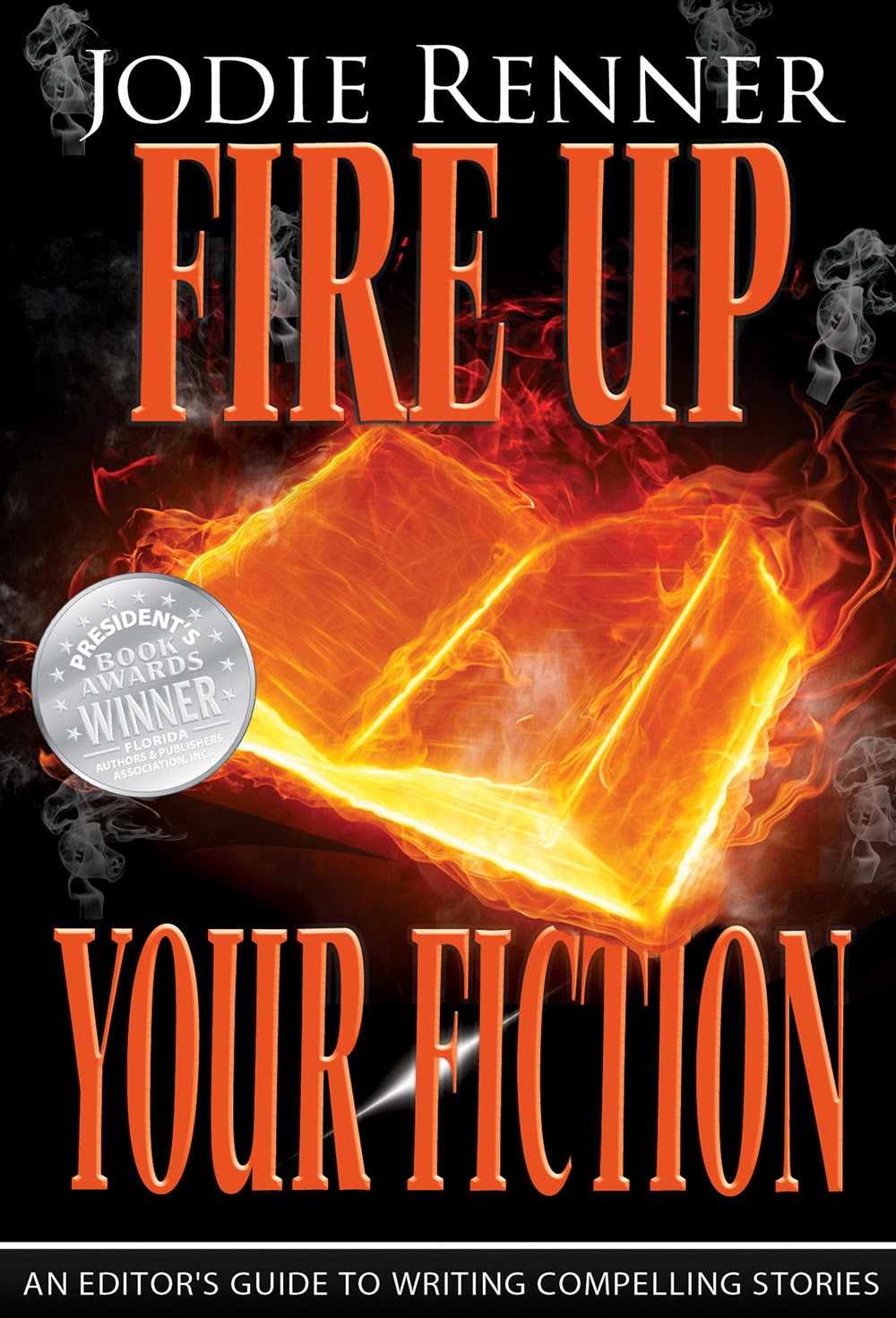
Jodie Renner has published two books to date in her series, An Editor’s Guide to Writing Compelling Fiction: Writing a Killer Thriller and Fire up Your Fiction which has won two book awards so far and is a finalist for 3 more. Look for the third book in the series, Captivate Your Readers, out in late 2014. For more info, please visit Jodie’s author website or editor website, her other blogs, The Kill Zone and Resources for Writers, or find her on Facebook, Twitter, and Google+. Also, sign up for her newsletter.

Sunday, March 10, 2013

Show Your Setting Through Your POV Character

by Jodie Renner, editor, author, & speaker  


Fiction writers – one of the fastest ways to bring your story world and characters to life is to portray the setting through the senses, feelings, reactions, and attitude of your protagonist.  

Enhancing your fiction by filtering the description of the settings through your viewpoint character’s senses is a concept I instinctively embraced when I first started editing fiction years ago. I was editing a contemporary middle-school novel, whose two main characters, a boy and a girl, were both eleven years old (I’ve changed the details slightly). The author had them describing rooms they entered as if they were interior decorators, complete with words like “exquisite,” “stylish,” “coordinated,” “ornate,” and “delightful.” Then, when they were in the park or the woods playing and exploring with friends, each tree, shrub and flower was accurately named and described in details that were way beyond the average preteen’s knowledge base or interests. 

Besides the obvious problem of too much description for this age group (or for any popular novel these days), this omniscient, literary, “grownup” way of describing their environment would not only turn off young readers due to the complex terms and sophisticated language, but also create a distance between any reader and these two modern-day kids. As a reader and editor, I didn’t feel like I was getting to know these kids at all, as I wasn’t seeing their world through their eyes, but directly from the author, who obviously knew her interior design terms and flora and fauna! By separating us from the main characters through this unchildlike, out-of-character description of their environment, the author inadvertently puts a kind of semi-transparent wall between us and the two kids. If we don’t get into their heads and hearts, seeing their world as they see it, how will we get to know them, and why will we care what happens to them?

I advise my author clients to not only show us directly what the characters are seeing around them, in the character's words and thoughts, colored by their attitude toward their surroundings, but to bring the characters and story to life on the page by evoking all the senses. Tell us what they’re hearing and smelling, too. And touching/feeling – the textures of things, and whether they’re feeling warm or cold, wet or dry. Even the odd taste. And don’t forget mood—how does that setting make them feel? Emotionally uplifted? Fearful? Warm and cozy? Include telling details specific to that place, and have the characters react to their environment, whether it’s shivering from the cold, in awe of a gorgeous sunset, or afraid of the dark. Bring that scene to life through your characters’ reactions!

This technique serves to deepen the characterization, bring the character to life, and make us feel like we're right there, while showing us the relevant, even critical aspects of the setting.

As Donald Maass says, in Writing the Breakout Novel, “Place presented from an objective or omniscient point of view runs the risk of feeling like boring descriptive. It can be a lump, an impediment to the flow of the narrative.”

He continues, “Do you have plain vanilla description in your current manuscript? Try evoking the description the way it is experienced by a character. Feel a difference? So will your readers.” 

James Scott Bell also advises us to “marble” the description of the environment in during the action. “The way to do this is to put the description in the character’s point of view and use the details to add to the mood.”

Jack M. Bickham gets more specific on this: “When you start a scene in which Bob walks into a large room, for example, you do not imagine how the room looks from some god-like authorial stance high above the room, or as a television camera might see it; you see it only as Bob sees it, coming in….” And include what he’s feeling, hearing, and smelling, too. Filter the scene through his perceptions and feelings. “This leads to reader identification with Bob, which is vital if the reader is to have a sense of focus.” 

Copyright © Jodie Renner

Resources:
James Scott Bell, Revision & Self-Editing
Jack M. Bickham, The 38 Most Common Fiction Writing Mistakes
Donald Maass, Writing the Breakout Novel
– And Jodie’s experience reading and editing fiction

P.S. Click HERE for some basic tips on creating sentences that flow, on Jodie's own blog.

Jodie Renner is a freelance fiction editor and the award-winning author of three craft-of-writing guides in her series An Editor’s Guide to Writing Compelling Fiction: Captivate Your Readers, Fire up Your Fiction, and Writing a Killer Thriller, as well as two clickable time-saving e-resources, Quick Clicks: Spelling List and Quick Clicks: Word Usage. She has also organized two anthologies for charity, incl. Childhood Regained – Stories of Hope for Asian Child Workers. You can find Jodie at www.JodieRenner.com, www.JodieRennerEditing.com, her blog, http://jodierennerediting.blogspot.com/, and on Facebook and Twitter.

Monday, February 11, 2013

Research and Realism

I'm busy traveling today, so my two-time client and all-round great guy, thriller and horror writer Allan Leverone, is filling in here at CFC for me today. Take it away, Al!
- Jodie Renner, freelance editor and craft-of-fiction writer


RESEARCH & REALISM, by Allan Leverone

As a genre author, my goal is to immerse the reader in the story. I want you turning the pages late into the night, knowing you should put the book down and go to bed but unable to force yourself to do so. I want you so involved in my fictional world that if the phone rings, you don’t even want to take your nose out of the book for three seconds to check the caller ID.

That’s my goal. And without putting words in anyone else’s mouth (or on anyone else’s keyboard), I think it’s probably a pretty safe bet that’s the goal of everyone who writes fiction.

In other words, I want to achieve a measure of realism you will accept as a reader. Since I’m only expert in a small number of subjects (people who know me might suggest that number is zero), a certain percentage of my time as an author must be spent in research.

I hate research.

Let me clarify: I like learning new things but don’t enjoy doing research for research’s sake. When I’m writing, I would much rather be writing than researching. I want to learn enough about a subject to ensure that you, as a reader, are not forced out of the story by a lack of realism in the writing.

My new thriller, Parallax View, is set late in the Cold War, in 1987, and action takes place inside the Kremlin, as well as in East and West Germany and the United States. The plot revolves around a secret communique, written by Soviet General Secretary Mikhail Gorbachev, to be delivered to U.S. President Ronald Reagan by beautiful and clever CIA clandestine ops specialist Tracie Tanner. A shadowy cabal is determined to ensure that communique never reaches the White House, and the chase is on.

As I mentioned before, there aren’t many subjects on which I could be considered an expert. What few subjects there are do not include KGB operations. Or CIA operations, for that matter. I’ve never been to the Kremlin. Never met Mikhail Gorbachev, although most of a couple of chapters in PARALLAX VIEW is spent inside his head.

To prepare for writing the book, I could have immersed myself in research; the subjects were certainly fascinating enough. But doing so could have meant taking years to write this one novel, rather than months, with only a minimal net gain in realism, if that. The stark reality of being a genre author early in the 21st century is that taking years to write a single book is not economically feasible.

So what’s the solution?

God bless the Internet. Instead of studying scholarly tomes on the history and construction of the Kremlin, instead of spending thousands of dollars I can’t spare to fly to Moscow (although I would love to do so some day), I was able to go online and inside of an hour’s time spent on the right websites, gain sufficient knowledge to allow me to write scenes with (hopefully) enough realism to keep the reader immersed in Tracie Tanner’s and Mikhail Gorbachev’s world, rather than our own.

The same thing goes for Soviet sniper gear. Soviet cigarettes, televisions, monitoring equipment. All these things required research, which I was able to do online in significantly less time than it would have taken twenty or thirty years ago. And my editor, Jodie Renner, collaborated by keeping an eye out for any possible discrepancies for the time period of the novel.
Another example: Ramstein Air Base in West Germany. Never been there. If you served in the United States military during the mid-1980s and your tour of duty took you through Ramstein, you may not recognize the base from its appearance in PARALLAX VIEW.

But here’s the point: you’re reading fiction. Ramstein Air Base is going to look like what I need it to look like to advance the story. My goal as a writer is to draw you into the fictional world through steadily increasing tension, and through characters who live and breathe and become real to you. If you’re looking for a detailed historical account of the Cold War, you should probably look elsewhere. If you’re interested in a detailed description of U.S. military bases in Europe during the Reagan years, you should probably look elsewhere.

But through the magic of the Internet, any writer can become well-enough versed in almost any subject to enable him or her to write compelling fiction. Because, after all, the cliché says authors should “write what you know.” With the web at your fingertips, you can now “know” almost anything.

That’s my opinion. What’s yours? Is it cutting corners to do all of your research online? Copping out? Are only ex-Soviet Red Army snipers capable of writing about Russian sniper activity?


Allan Leverone is the author of the Amazon Top-25 bestselling thriller, THE LONELY MILE, as well as four other novels, including the brand-new PARALLAX VIEW. He's an air traffic controller in the real world and lives with his family in Londonderry, New Hampshire. Connect on Facebook, Twitter @AllanLeverone, and at http://www.allanleverone.com/.
Click on these titles to go to Allan's novels on Amazon: Parallax View, Revenant, Paskagankee, The Lonely Mile, and Final Vector.

Saturday, December 1, 2012

Step Away From the Desk


 Guest post by Kelly Miller, crime fiction novelist

I’m sure you’ll all agree technology has made the writer’s life easier. No more trips to the library, just Google it. No more visits to the courthouse, instead check records online. Now that we have Google Earth is there a need to travel to the corner of Cherry & Main when you can simply power up the computer and visit electronically? But this begs the question, have we become too dependent on technology?

It’s tempting to lean on our computer crutch. A writer has so few minutes free in the day. If we’re not writing our next novel, we’re endlessly blogging, tweeting, and facebooking. So I can understand our dependence on virtual travel. But I say, “Step away from the desk!” 

If you simply rely on a picture on a computer screen, you’ll miss out on the nuances of a location, the flavor of a city. Researching for my debut novel, Dead Like Me, I set up a private three-hour tour of the Tampa Police headquarters. It was the best thing I could have ever done for my novel. I like to keep my stories as factual as possible so I wanted to record everything. Like the fact that the homicide department is on the eighth floor and how the precinct has a nondescript smell. Unless of course, you’re on the fourth floor when seized marijuana plants are drying out. 

As a crime fiction writer, police anecdotes and rookie mistake stories are golden. When I toured the homicide department, I discovered the guys had played a practical joke on one of the detectives. They turned his desk into a boat, attaching a steering wheel to the end of the desk and PVC piping to the top creating a bimini. A steel cleat was even mounted right in the middle of his desk. Of course this was too good to pass up, so I included it in my novel. These are all things I never would have found out through interviews or sitting behind my computer. 

How about you? Do you rely heavily on your computer for research, or do you get out from behind your desk and travel, soaking up the local flavor of a location? Or maybe you use a combination of the two approaches?


Kelly Miller’s first novel, Dead Like Me, debuted November 29. To purchase a copy, visit www.blackrosewritingbooks.com. You can learn more about Kelly by visiting her website at www.kellymillerauthor.com or her blog at http://apps.kellymillerauthor.com/blog.

Monday, June 4, 2012

Stimulus and Response — Phrasing for Immediacy and Power


by Jodie Renner, freelance editor

Have you ever been engrossed in a novel, reading along, then you hit a blip that made you go “huh?” for a nanosecond? Then you had to reread the sentence to figure out what’s going on? Often, it’s because actions are written in a jumbled-up order, rather than the order they occurred. When writing fiction, it’s usually best to show actions and events in chronological order, and to describe the cause first, then the effect. Something happens, then the character reacts to it, not the other way around.

So when showing actions and reactions in your fiction, pay attention to the syntax of the sentence. State the cause before the effect, the action before the reaction, the stimulus before the response. This way, the ideas flow more naturally and smoothly, and the readers don’t have to skip back in the sentence to figure out what’s going on, which confuses them momentarily and takes them out of the story.

As Ingermanson and Economy say in Writing Fiction for Dummies, “Here’s a critical rule: Always get the time sequence correct and always put the cause before the effect.”

Here are some “before and after” examples, disguised, from my fiction editing. The “after” examples are just one or two of many possibilities.

State cause before effect, action before reaction, stimulus before response:

Instead of: David yelled out in pain when the door slammed on his fingers.

Write: The door slammed on David’s fingers and he yelled out in pain.

Or: The door slammed on David’s fingers. He leaped back and yelled out in pain.

Instead of: She pulled her arm away when the man tried to grab her.

Write: The man tried to grab her, but she pulled her arm away.

Or: The man tried to grab her arm, but she pulled away.

Describe physically sequential actions in the order they occurred:

Instead of: Jake walked the five hundred yards over to the police station and left his car in front of the restaurant.

Write: Jake left his car in front of the restaurant and walked the five hundred yards over to the police station.

Instead of: Rushing to escape the flames, he turned towards the fire escape as soon as he'd left the room.

Write: Rushing to escape the flames, he ran out of the room towards the fire escape.

Instead of: Boyd jumped out of the car as he reached the parking lot and ran into the bar.

Write: Boyd drove into the parking lot, jumped out of the car, and ran into the bar.

If you don’t write the actions in the order they occurred, it causes momentary confusion for the reader. Do that enough and they start getting subliminally annoyed.

Watch those “ing” verbs:

Also, avoid using the way-too-common “ing” verbs for actions that occur one after the other. Verbs ending in -ing imply simultaneous action where there is none:

Instead of: She slammed the car door, running up the sidewalk.

Write: She slammed the car door, then ran up the sidewalk.

Instead of: He took out his keys, starting the car.

Write: He took out his keys and started the car.

In the “before” examples above, the –ing verbs imply that the actions occurred at the same time, which is impossible—she can’t run up the sidewalk as she’s slamming the door. He can’t start the car while he’s taking out his keys.

Instead of: He disappeared for fifteen years, coming back better dressed, and full of stories.

Write: He disappeared for fifteen years, then came back better dressed and full of stories

Instead of: Sarah stood up and stretched, ambling over to the trash can, tossing her empty coffee cup and the newspaper into it.

Write: Sarah stood up and stretched, then ambled over to the trash can and tossed her empty coffee cup and the newspaper into it.

Think through action or fight scenes and chases:

Writing so that one action happens after another, in a logical sequence, makes for a smoother, more natural, flow of ideas. This can be especially troublesome for fight scenes or chases, where so much is happening that it’s easy for the readers to get confused. For example:

Before: In this scene as it was originally written, the sequence of events is unclear and out of order, with essential actions missing.

Another officer leaped from a second PD unit that had been following dogging the two officers, taking the stance with a drawn gun aimed at the pickup. Kurk slammed the truck in reverse and gunned the engine, knocking down the officer behind him, dragging him as he smashed the gears into drive, then gunning it forward using the truck as a battering weapon. Just then a delivery truck parked at the far end of the alley. Kurk slammed the truck in reverse seeing the end of the alley blocked by the delivery truck.

After: As it’s written now, it’s much easier to visualize what’s going on.

Another officer leaped from a second PD unit that had been dogging the two officers. He sprinted toward the alley, then took the stance with a drawn gun aimed at the pickup. Kurk slammed the truck in reverse and gunned the engine, knocking down the officer behind him, then smashed the gears into drive and gunned it forward, dragging him along as he used the truck as a battering weapon. Just then a delivery truck parked at the far end of the alley. Seeing the end of the alley blocked by the delivery truck, Kurk slammed the truck in reverse.

But sometimes it’s good to break the “stimulus before response” rule:

To add more suspense and intrigue, occasionally it’s effective to show a character’s reaction to something shocking before describing what she is reacting to. In this case, you’ll create a more dramatic effect if you have your character react first, and then show what it is she’s seeing. This way, you’ll have a moment of suspense between the horrified reaction and the revelation of what’s being seen. Also, it may take a paragraph or more to describe what she’s seeing, so her reaction would be delayed, which can be a bit anticlimactic.

Example:

“…the beam of her flashlight scanned the floor ahead. She stopped and gasped in horror.

Calvin lay on the concrete, his eyes starting unseeing at the ceiling. Blood spattered the floor around him. His throat had been cut from ear to ear.”


Jodie Renner is a freelance fiction editor and the award-winning author of three craft-of-writing guides in her series An Editor’s Guide to Writing Compelling Fiction: Captivate Your Readers, Fire up Your Fiction, and Writing a Killer Thriller, as well as two clickable time-saving e-resources, Quick Clicks: Spelling List and Quick Clicks: Word Usage. She has also organized two anthologies for charity, incl. Childhood Regained – Stories of Hope for Asian Child Workers. You can find Jodie at www.JodieRenner.com, www.JodieRennerEditing.com, her blog, http://jodierennerediting.blogspot.com/, and on Facebook and Twitter.   

Sunday, January 15, 2012

Show Those Feelings — and Reactions!


by Jodie Renner, editor, author, & speaker        

One of the main reasons I put down a book is because it seems flat to me, the characters cardboard cutouts, the protagonist bland, bored and boring, or even cold and unfeeling. If the characters don’t seem to care about others or react to what’s happening to them, why should I?

Most fiction is character-driven, and to get into the story, we need to be able to identify closely with the protagonist. And we won’t do that unless they have some warmth and determination and hopes and dreams and insecurities and fears – and react to things! Then we feel and react too, along with them, and start to worry about them and cheer for their small victories. Once you have your readers fretting about your hero and rooting for him, they’re hooked.

As Jack M. Bickham says, “Fiction characters who only think are dead. It is in their feelings that the readers will understand them, sympathize with them, and care about their plight.”

So bring your characters to life by showing their deepest fears, worries, frustrations, hopes and jubilations. If readers see your hero pumped, scared, angry or worried, they’ll feel that way, too. And a reader who is feeling strong emotions is a reader who is turning the pages.


Jessica Page Morrell tells us that in fiction, the writer’s main responsibility is to “make the readers care; that is, bring us to tears or outrage or heart-thumping worry. Stories with emotional power engage the reader’s intellect, senses, and emotions as he sees and hears the unfolding action.”

Donald Maass wrote a whole book, The Fire in Fiction, dedicated to putting passion into your writing. In discussing your opening, he says, “Too many manuscripts begin at a distance from their protagonists, as if opening with a long shot like in a movie. That’s a shame. Why keep readers at arm’s length?”

He continues, “Novels are unique among art forms in their intimacy. They can take us inside a character’s heart and mind right away. And that is where your readers want to be. Go there immediately.”

And emotions take the reader into your story world, too. As Maass says, "It is the combination of setting details and the emotions attached to them that, together, make a place a living thing. Setting comes alive partly in its details and partly in the way that the story's characters experience it." 

So always take time to show the characters’ feelings, thoughts and reactions to what’s happening around them. Don’t let a stimulus go without a response, an action without a reaction. And as your characters respond, so do your readers.


But don’t go overboard with it — you don’t want your protagonist to come across as gushing or hysterical or neurotic. It’s important to strike a balance so the readers want to relate to and empathize with your main character, not get annoyed or disgusted with her and quit reading.
As Morrell says, “Emotions also help propel a story forward, but it’s not easy to strike the exact balance of emotions in each scene. No emotions on the page, no emotions in the reader.” BUT “Melodrama on the page and you inspire indifference in the reader.”

She continues, “Beginning writers often fall into the trap of overdoing with shrillness or silliness. Their characters have hair-trigger tempers and are forever howling in fury, throwing tantrums, and issuing ultimatums. On the flip side, sometimes beginners pen a sob story of misty-eyed sentiments or a way-too-cheerful and saccharine, gee-whillikers tale.”

But you don’t want to have a story that leaves readers “feeling nothing besides shades of boredom.” So how do we strike that balance? How do we as writers find the emotions to bring our characters to life, but also find a happy medium between flat, emotionless characters that bore us and hysterical drama queens that make us cringe?

Morrell advises, “Since emotions are embedded in the human condition, you need to find a way to portray jealousy, betrayal, grief, misery, rage – the whole gamut of strong emotions – with nuance yet believability.” Friends, beta readers and critique groups can be an invaluable help with this.

Jack M. Bickham advises us to consider how we’ve felt in similar circumstances, then over-write first, and revise down later. “I would much prefer to see you write too much of feeling in your first draft; you can always tone it down a bit later…. On the other hand, a sterile, chill, emotionless story, filled with robot people, will never be accepted by any reader.” He counsels writers to “avoid the impulse to play safe.”

In Part II of this article, we’ll discuss specific techniques on finding those emotions and striking a balance between showing too little and too much emotion.

Do you have any techniques for bringing out your characters’ reactions and feelings? And for ensuring that you don’t go off the deep end with it?

Resources: Jack M. Bickham, The 38 Most Common Fiction Writing Mistakes; Donald Maass, The Fire in Fiction; Jessica Page Morrell, Thanks, But This Isn’t For Us.

For more info, see "Appeal to the Senses -- and Emotions!" Jan. 10, 2012


Jodie Renner is a freelance fiction editor and the award-winning author of three craft-of-writing guides in her series An Editor’s Guide to Writing Compelling Fiction: Captivate Your Readers, Fire up Your Fiction, and Writing a Killer Thriller, as well as two clickable time-saving e-resources, Quick Clicks: Spelling List and Quick Clicks: Word Usage. She has also organized two anthologies for charity, incl. Childhood Regained – Stories of Hope for Asian Child Workers. You can find Jodie at www.JodieRenner.com, www.JodieRennerEditing.com, her blog, http://jodierennerediting.blogspot.com/, and on Facebook and Twitter.


Monday, June 6, 2011

Writing a Killer Thriller, Part II

by Jodie Renner
Some key techniques for writing a compelling suspense-thriller…or any other page-turner.
In Part I of this series, I offered some tips for creating a killer opening; staging intriguing, complex characters; and engaging your reader quickly through an up-close point of view. Those techniques, used well, will set the stage and grab your readers early on, making them bond quickly with your hero and start worrying about his plight.
How to keep your readers involved right through to the end of the book? Plan for conflict, tension and suspense on every page, and deliver it with a tight, to-the-point writing style. Don’t allow your reader’s attention to wander for a moment!
 
Devise a riveting plot, with lots of conflict and tension.
Conflict drives all fiction. And more conflict and higher stakes are of course necessary for a successful thriller. Put your protagonist in hot water right away. Then up the stakes and create more problems for him. Then more.
As James N Frey says, “Have your characters in terrible trouble right from the beginning, and never let them get free of terrible trouble until the climax. Keep the clock ticking and the excitement mounting right to the climactic moment.”
Unlike some other genres, in a thriller, you need high stakes and an urgent mission, and you need to keep the plot moving along briskly. Don’t bog it down with explanations and digressions and backstory. Add those in in small doses, marbling them into your story only when needed. And color any exposition (internal monologue) with plenty of tension, anxiety, inner conflict, questions, all expressed with a distinctive voice and lots of attitude.
Jessica Page Morrell, in Thanks, But This Isn’t For Us, has this advice for creating effective conflict:

~ Give characters opposing goals, agendas, and strong motivations.

~ Make sure the stakes for each character are high.

~ Stage confrontations as if they’re happening/unfolding in real time.

~ Embed dialogue with tension, subtext, and power exchanges.

~ Know your protagonist’s deepest fears.


Stir in lots of suspense.
As Morrell says, “Suspense forces a reader to stay engaged and is part anxiety, part curiosity. Suspense unsettles the reader, plunges him into nail-biting angst. … Suspense builds and satisfies when the reader desperately wants something to happen and it isn’t happening.”
Suspense is usually caused by threats, when the protagonist whose head we’re in is in danger, his life is about to become a living nightmare, and we have to keep reading to find out how it all turns out.
Some techniques to use to increase the suspense are subtle foreshadowing, delaying information, subterfuge, threats to the protagonist, time running out, inner conflicts, surprise twists, and cliff-hangers. All of these techniques involve delaying the resolution of the hero’s problems, piling on new challenges, and hinting of even worse dangers to come.


Use a tight writing style. Make every word count.
In a suspense-thriller (or any compelling fiction), it’s important to write economically. As Steve Berry says: “Shorter is always better. Write tight. It makes you use the best words in the right way.” Succinct, to-the-point writing produces the predominantly fast pace demanded by thrillers.
Don’t meander or ramble. Don’t wax eloquent. Don’t use highfalutin words that sound pompous and will send your readers to the dictionary. Direct, sensory, evocative words are much more powerful. As Jessica Page Morrell says, “Simple words are close to our hearts and easily understood.” Avoid the convoluted, erudite sentence structure popular in previous centuries. And don’t say the same thing three or four times in different ways – we got it the first time! Also, stay away from those stale clichés.
As Harlan Coben says about writing his thrillers, “I want it to be compulsive reading. So on every page, every paragraph, every sentence, every word, I ask myself, ‘Is this compelling? Is this gripping? Is this moving the story forward?’ And if it’s not, I have to find a way to change it…. No word really should be wasted.”
 
See Part III for more tips on writing a riveting thriller, and Jodie's book, Writing a Killer Thriller.    
 
Resources:
Steve Berry’s 8 Rules of Writing, Writer’s Digest, September 05, 2008
Harlan Coben, in an interview by Jessica Strawser published in Writer’s Digest, “Straight Talk with Harlan Coben,” November 29, 2010.
James N. Frey, How to Write a Damn Good Thriller – A Step-by-Step Guide for Novelists and Screenwriters.
Jessica Page Morrell, Thanks, But This Isn’t for Us, A (Sort of) Compassionate Guide to Why Your Writing Is Being Rejected

Jodie Renner, a freelance fiction editor specializing in thrillers and other fast-paced fiction, has published two books to date in her series, An Editor’s Guide to Writing Compelling Fiction: WRITING A KILLER THRILLER and STYLE THAT SIZZLES & PACING FOR POWER (Silver Medalist in the FAPA Book Awards, 2013). Both titles are available in e-book and paperback. For more info, please visit Jodie’s author website or editor website, or find her on Facebook or Twitter.

Monday, May 9, 2011

Show, Don't Tell

by Jodie Renner
“Show, don’t tell” is the most common mantra among advisors to fiction writers. It’s about bringing the scene alive and putting the reader right there, inside your characters, experiencing her fear along with her, feeling the sweat on his brow and his adrenaline racing, your pulse quickening right along with theirs, muscles tensed, ready to leap into action.
            A common mistake among aspiring fiction writers is to describe or narrate (tell) events as if they took place at some point in the past, instead of putting the reader right in the middle of the action and showing the events as they occur, in real time, along with the characters’ reactions, feelings, and actual words (direct dialogue).
To clarify what is meant by “show, don’t tell,” think of it this way: Which would you rather do, go see a great movie in a theatre with a big screen and surround sound (“show”), or hear about the movie from someone else afterward (“tell”)? That’s the difference we’re talking about here.
            According to Ingermanson and Economy, “Showing means presenting the story to the reader using sensory information. The reader wants to see the story, hear it, smell it, feel it, and taste it, all the while experiencing the thoughts and feelings of a living, breathing character. Telling means summarizing the story for the reader in a way that skips past the sensory information and goes straight to the facts.”
Janet Evanovich considers “show, don’t tell” to be one of the most important principles of fiction: “Instead of stating a situation flat out, you want to let the reader discover what you're trying to say by watching a character in action and by listening to his dialogue. Showing brings your characters to life.”
As Jack Bickham says, “Not only does moment-by-moment development make the scene seem most lifelike, it’s in a scene [with dialogue and action and reaction] where your reader gets most of his excitement. If you summarize, your reader will feel cheated – short-changed of what he reads for – without quite knowing why.”
            Shelly Thacker points out, “Readers of popular fiction don’t want to experience the events of your novel at a distance; they want to FEEL what’s happening. They want to laugh, cry, hope, worry.” Shelly advises, “Strive for more dialogue than narrative. … Narrative tends to slow things down and usually leads to telling instead of showing…. Showing with action and dialogue creates vivid characters and a fast pace; telling only bogs down your story.”
Also, the bulk of the scene needs to be about a conflict of some kind between characters. No conflict = no scene. According to Jack Bickham, the conflict part of the scene “draws readers out through a moment-by-moment drama, extending the scene suspense with pleasurable agony.”
Of course, you can’t show everything, or your book would be way too long, and it would tire your readers out – or worse, end up boring them. According to James Scott Bell, “Sometimes a writer tells as a shortcut, to move quickly to the meaty part of the story or scene. Showing is essentially about making scenes vivid. If you try to do it constantly, the parts that are supposed to stand out won’t, and your readers will get exhausted.”
The rule, says Bell, is “the more intense the moment, the more showing you do.” That’s the difference between scene and summary. You don’t want to describe every move your characters make at down times, or when going from one place to the other. That’s where you summarize or “tell,” to get them to the next important scene quickly, without a lot of boring detail. 
           The main thing to keep in mind is to never to tell the reader, after the fact (or have a character telling another character), about a critical scene. Instead, dramatize it in the here and now, with dialogue, action, and lots of sensory details to bring it to life for the reader.

Resources: Revision and Self-Editing by James Scott Bell; The 38 Most Common Fiction Writing Mistakes (And How To Avoid Them) by Jack M. Bickham; Writing Fiction for Dummies, by Randy Ingermanson and Peter Economy; “10 Tips for a Top-Notch Novel” by Shelly Thacker (www.ShellyThacker.com).

Jodie Renner, a freelance fiction editor specializing in thrillers and other fast-paced fiction, has published two books to date in her series, An Editor’s Guide to Writing Compelling Fiction: WRITING A KILLER THRILLER and STYLE THAT SIZZLES & PACING FOR POWER (Silver Medalist in the FAPA Book Awards, 2013). Both titles are available in e-book and paperback. For more info, please visit Jodie’s author website or editor website, or find her on Facebook or Twitter.