Showing posts with label writing crime fiction. Show all posts

Monday, November 5, 2012

RESOURCES FOR CRIME WRITERS - BOOKS

by Jodie Renner, freelance editor


To continue my series on resources for crime writers, here's a list of craft and other resource books for writers of thrillers, mysteries, and other crime fiction. For a list of organizations, conferences, and some blogs related to crime fiction, see my recent post, Some Great Resources for Crime Fiction Writers and Readers.


BOOKS ON WRITING THRILLERS, MYSTERIES, AND OTHER CRIME FICTION:

“HOW TO WRITE A THRILLER,” from Amazon, list with links:

How to Write a Damn Good Thriller: A Step-by-Step Guide for Novelists and Screenwriters by James N. Frey

Elements of Fiction Writing - Conflict and Suspense by James Scott Bell

Writing a Killer Thriller (An Editor's Guide to Writing Compelling Fiction) by Jodie Renner

Writing the Thriller by Trish Macdonald Skillman 

The Arvon Book of Crime and Thriller Writing by Michelle Spring and Laurie R. King

Write a Bestselling Thriller: A Teach Yourself Creative Writing Guide by Matthew Branton

How to Write a Thriller by Scott Mariani

Writing the Thriller Film: The Terror Within (Michael Wiese Productions) by Neill D. Hicks

Writing for Emotional Impact: Advanced Dramatic Techniques to Attract, Engage, and Fascinate the Reader from Beginning to End by Karl Iglesias

Writing a Thriller by André Jute


“HOW TO WRITE A MYSTERY NOVEL,” from Amazon, list with links:

How to Write a Damn Good Mystery: A Practical Step-by-Step Guide from Inspiration to Finished Manuscript by James N. Frey

Writing and Selling Your Mystery Novel
Writing and Selling Your Mystery Novel by Hallie Ephron

Don't Murder Your Mystery [Agatha Award for Best Nonfiction Book] by Chris Roerden (2006)


Writing Mysteries by Sue Grafton (2002)

The Elements of Mystery Fiction: Writing the Modern Whodunit by William G Tapply

How to Write a Mystery by Larry Beinhart

How to Write Killer Historical Mysteries: The Art and Adventure of Sleuthing Through the Past by Kathy Lynn Emerson

Youdunit Whodunit! How to Write Mysteries by Nicola Furlong (2009)

Mystery Writing in a Nutshell by John McAleer, Andrew McAleer and Edward D. Hoch

How to Write Killer Fiction: The Funhouse of Mystery & the Roller Coaster of Suspense by Carolyn Wheat
How to Write a Dick: A Guide for Writing Fictional Sleuths from a Couple of Real-Life Sleuths by Shaun Kaufman and Colleen Collins

Breaking Into The Mystery Short Story Market: It's No Crime! by Brendan DuBois

Write Good or Die by Scott Nicholson, Gayle Lynds, Kevin J. Anderson and M.J. Rose


“WRITING CRIME FICTION,” from Amazon, list with links:

Police Procedure & Investigation: A Guide for Writers (Howdunit)Police Procedure and Investigation: A Guide for Writers (Howdunit) by Lee Lofland

Writing Crime Fiction by Naomi Hirahara, Max Allan Collins, Stephen Gallagher and Dave Zeltserman

The Crime Interviews Volume One: Best-selling Authors Talk About Writing Crime Fiction by Len Wanner and Louise Welsh

Crime Writing Tips For Beginners by Kelvin Jones

The Crime Interviews Volume Three: Best-selling Authors Talk About Writing Crime Fiction by Len Wanner and William McIlvanney

Meet a Jerk, Get to Work, How to Write Villains and the Occasional Hero by Jaqueline Girdner and Ronald Hudson

More Forensics and Fiction: Crime Writers Morbidly Curious Questions Expertly Answered (Marder and Mayhem)
More Forensics and Fiction: Crime Writers Morbidly Curious Questions Expertly Answered (Murder and Mayhem) by Douglas P. Lyle

The Oxford Companion to Crime and Mystery Writing by Rosemary Herbert, Catherine Aird, John M. Reilly and Susan Oleksiw

Crime Fiction (The New Critical Idiom) by John Scaggs

Writing a Killer Thriller (An Editor's Guide to Writing Compelling Fiction) by Jodie Renner

The Writer's Complete Crime Reference Book by Martin Roth

The Cambridge Companion to American Crime Fiction (Cambridge Companions to Literature) by Catherine Ross Nickerson

The Crime Writer's Reference Guide: 1001 Tips for Writing the Perfect Murder by Martin Roth (2003)
Now Write! Mysteries: Suspense, Crime, Thriller, and Other Mystery Fiction Exercises from Today's Best Writers and Teachers by Sherry Ellis and Laurie Lamson

The Crime Writer by Gregg Hurwitz

Forensics For Dummies by Douglas P. Lyle
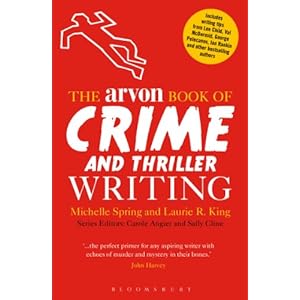
The Arvon Book of Crime and Thriller Writing
Howdunit Forensics by D. P. Lyle

The Arvon Book of Crime and Thriller Writing by Michelle Spring and Laurie R. King

Body Trauma: A Writer's Guide to Wounds and Injuries (Get It Write) by David W. Page

The Criminal Mind by Katherine Ramsland

The Crime Writer's Handbook (Allison & Busby Writers' Guides) by Douglas Wynn (2004)
(5 stars, 1 customer review)

Teach Yourself Writing Crime Fiction by Lesley Adamson

Crime Writers Reference Guide by Martin Roth

The Crime Interviews Volume Two: Best-selling Authors Talk About Writing Crime Fiction by Len Wanner and Ian Rankin

FBI Handbook of Crime Scene Forensics by Federal Bureau of Investigation (2012)

Writing Crime Novels by John Paxton Sheriff


Writing Bestselling True Crime and Suspense: Break into the Exciting and Profitable Field of Book, Screenplay, and Television (Writing Guides) by Tom Byrnes

Writing Crime and Suspense Fiction: And Getting Published (Teach Yourself Series) by Lesley Grant-Adamson

How to Write Crime by Marele Day

How to Write True Crime That Sells by Gera-Lind Kolarik and Delores Kennedy

Writing Crime Fiction (Writing Handbooks) by Henry Reymond Fitzwalter Keating

Scene of the Crime: A Writer's Guide to Crime Scene Investigation (Howdunit Series) by Anne Wingate (1992) (av. 4.5 stars, 14 customer reviews)

Amateur Detectives: A Writer's Guide to How Private Citizens Solve Criminal Cases (Howdunit Writing) by Elaine Raco Chase and Anne Wingate (1996) (av. 3.5 stars, 6 reviews)

Police Procedural: A Writer's Guide to the Police and How They Work (Howdunit) by Russell L. Bintliff (Sep 1993) (av. 3.5 stars, 9 customer reviews)

Armed and Dangerous: A Writer's Guide to Weapons (Howdunit Writing) by Michael Newton (Aug 1990) (av. 3 stars, 9 customer reviews)

Deadly Doses: A Writer's Guide to Poisons (Howdunit Writing) by Serita Deborah Stevens and Anne Klarner


Also:

BBC: Writing Crime Fiction A master-class held by crime fiction authors Minette Walters and Mark Billingham in March 2004.

Raymond Chandler, The Simple Art of Murder

Writers and readers: Do you have any good craft or resource books to add, for crime fiction writers? Or any opinions on any of the titles listed here? Any you've found particularly useful? Please let us know in the comments below. Thanks!

Jodie Jodie Renner, a freelance fiction editor specializing in thrillers and other fast-paced fiction, has published two books (& e-books) to date in her series, An Editor’s Guide to Writing Compelling  Fiction: Writing a Killer Thriller and Style that Sizzles & Pacing for Power, both in e-book & print. Upcoming book: Immerse the Readers in Your Story World. For more info, please visit Jodie’s author website or editor website, or find her on Facebook or Twitter, and read her blog posts on The Kill Zone and Resources for WritersTo subscribe to Jodie’s "Resources for Writers" newsletter please click on this link.


Wednesday, October 31, 2012

Should I query agents or self-publish?

By Andrew E. Kaufman, author of psychological thrillers

As soon as I started selling a lot of books, I also started getting a lot of emails from other authors, and one of the most frequently asked questions (besides "what’s your secret?") was whether they should self-publish or query agents.

I’m never quite sure how to answer that question, because it seems like an extremely personal choice--kind of like, “Should I go to college or try a trade school?” Only a qualified counselor can help answer that question, and they need a lot of information to help you make an informed decision.

Besides, what’s right for one person certainly isn’t right for the next, and I always feel hesitant to give advice when it seems so subjective. I don’t know an author’s circumstances, so it’s difficult to help them decide. I’m not an expert; I’m just another author, and all I can really do is speak from my own experience, which really is just one perspective of many.

But having said that, I did learn a few things along the way, and I’m always happy and willing to talk about them, because I know how frustrating and heartbreaking it can be to have something you’re proud of and then struggle to find others who will feel the same enthusiasm.

First, there are some questions you should ask yourself, ones I asked too, that helped me choose my own path. Here are a few of them:

What stage are you at in your process?

Have you already gone the querying route and found little success? If so, self-publishing may very well be a good option.

I tried for traditional publishing at first, because back then it was the only option available. I wanted more than anything to find an agent and publisher, but after receiving hundreds of rejections, I gave up. Then, once e-publishing (specifically, the advent of the Kindle) came along, I decided to try that. 

Within a few years, I was selling a lot of books, making a nice living, and most important, was doing what I loved. Even better, I was the one in control. It was a great feeling, and suddenly having a publisher didn’t seem to matter much at all. 

As it turned out, I was eventually approached by agents asking if I was interested in representation and ended up going with one of them. So in the long-run I ended up exactly where I'd been trying to go in the first place—I just found a different door. 

How important is it to have a publisher’s name behind your work instead of your own?

Once I found success as an author (which incidentally, is a relative word, and in my opinion, should be defined by much more than sales) I realized that having a publisher’s name behind my work paled in comparison to the strides I was making on my own. Were there people still snubbing their noses at me? Absolutely. Did it bother me? Not so much because I knew I was achieving exactly what my “legitimate” counterparts were. I was just doing it in a different way.

For some, it’s still important to be associated with a traditional publisher, but I believe that’s quickly changing, and eventually, it won’t much matter. For me, getting my books into readers' hands was all I wanted, and now I'm doing that.

Are you willing to give up certain things?

If you go the traditional route you will make sacrifices—at least if you’re just starting out—and depending on which publisher you go with, the degree will vary. For one, you won’t have as much creative control over your work. Largely speaking, most traditional publishers have the final word over the content of your work (including your cover). As an indie author, it’s all up to you. For some, that's a big bonus.

Same thing goes for your profit margin. Being an indie author gives you far more leeway in this area. KDP currently offers a 70% profit on gross sales (for books $2.99 and up). Being with a traditional publisher will likely get you far less.
For some, this is extremely important. For others, not so much. So you should ask yourself how much control you’re willing to hand over to a publisher, and even more important, understand the terms of your agreement before you sign with them.

Can an agent help you reach your goals?

First of all, what are your goals? This was a question I struggled with before making my decision to finally work with an agent. When mine approached me, my first question was, how will I benefit from this relationship? His answer was that he wanted to help take my career to the next level, which made sense because that was also my own goal. Right now, he manages the foreign, audio, and television/film rights for my work, as well as those for U.S. publishing. I’ve recently signed a lucrative deal, which I hope—at least from my perspective—will indeed take my career to the next level.

The thing to keep in mind is that whatever decision you do make, you should be fully aware that this industry is changing at breakneck speed, and you have to think on your feet. What works for me—or anyone else—is likely going to change sooner rather than later. Do I think going indie is a great way to go? Absolutely. Do I think it’s a way to open doors that were previously closed off? You bet.

Do I think it’s the best route for you?

That’s for you to decide.

Andrew E. Kaufman is the author of The Lion, the Lamb, the Hunted and While the Savage Sleeps, both Amazon top 100 bestsellers this year. His books are the most borrowed, independently published books in the Kindle Owners' Lending Library, and his combined sales have reached well into the six-figure mark. He is represented by Scott Miller, Executive Vice President of Trident Media Group in New York. For more info about his work, please visit his website at: www.andrewekaufman.com


Thursday, October 4, 2012

SAFECOP – a New Weapon in Tampa’s Arsenal

Guest post by Kelly Miller
The crime fighters in our novels don’t rely on Ouija boards to capture the bad guys. They use the latest technology available. If you write crime fiction, it’s imperative you familiarize yourself with the systems police departments across the country use.

When the Republican National Convention came to Tampa, Florida, last month, the Tampa Police Department was thrust into the national spotlight. Chief Jane Castor and her officers performed exceptionally well under the stress of picketers and two weeks of twelve-hour shifts. There were even Tampa residents interviewed on the local news, complaining how quiet downtown was during the RNC. If that was the worst criticism of the week, I’d say the TPD exceeded expectations.

One benefit of the convention was the purchase of a $400,000 software upgrade from Congressional money set aside for convention security. This technology allows Tampa officers to continuously scan updated maps for crime trends. When police respond to a crime scene, they enter the information collected into the system and Tampa maps are updated instantaneously. This software also allows officers access to maps showing career criminals, sexual predators, and juvenile offenders living in a specific area.

In the past, if the TPD wanted to send out a BOLO (Be on the Look Out), it could take several hours or even days for officers to receive the information. Now alerts happen in real time. Investigators can send out these bulletins using the new software as well as post photos and videos.

Shortly after the RNC, the bay area got to see this new software in action when a burglary suspect was arrested. Reportedly a man broke into an office building, ransacked the place, and stole cash and audiovisual equipment. Burglary cases often take at least a few days to solve, if solved at all. But this suspect was arrested in only two hours. Police checked the burglarized company’s surveillance video and found an image of the suspect. An officer used a cellphone camera to take a picture of the man in the video. Then the photo and a description of the suspect were entered into the new system and it quickly lead to his capture.


Kelly Miller’s first novel, Dead Like Me (due out November 29), is set in Tampa, Florida where she lives. This technology isn’t something her detectives use, but the third book in the Kate Springer series will be set during this time period—September 2012. Kelly is hoping the backdrop of the RNC and new technology like SAFECOP will add extra flavor to the story. Please visit Kelly's website and her blog.