Wednesday, August 31, 2011

I Wasn't Putting Myself First (Or, Deconstructing Superman)


By Andrew E. Kaufman

This post isn’t going to be about crime fiction or even about publishing—not really, anyway. This post is about life. About being human, realizing we’re not perfect, that we can’t do it all.

Sometimes, I think, many of us forget that.

It’s easy to do. Life can often get in the way. I remember before I published my first novel, things seemed a lot less complicated. That’s not a complaint; it's an observation. Juggling my personal and professional life is more of a challenge now, and with that, it’s easy to get caught up in the swell of activity and forget what matters. It’s not unusual—it’s just life.

But sometimes too, if we’re lucky, we get reminders, warnings, even, to slow down and stop trying to be everything to everyone, because quite simply, we can’t.

It’s not like anyone was asking anything extraordinary of me. I was doing a good enough job of that myself, getting tangled-up in Life’s Rut. I wasn’t selling enough books, needed to write better ones, was worried about pleasing my readers, my family, my friends.

Pleasing everyone, that is, except for me.

“Yes” had become a staple in my vocabulary, and “no” a word I hardly recognized anymore. I wasn’t eating right, not working out, getting very little sleep. It’s a familiar theme in my life, a slippery slope I often unknowingly fall down. And usually, it takes a slap in the face to bring me back down to earth, make me realize that I am, in fact, not Superman, that I can’t do it all.

I got my wakeup call.

And then, a question: What the hell are you doing? I didn’t have an answer, didn’t even remember how I got here, and suddenly, felt kind of foolish and a little bit angry. I just wanted to be the successful author, the good son, the reliable friend. But at what cost? Compromising my health? Giving away a little of my self-esteem each time I said yes when I should have said no? Admittedly, I’m an overachiever, but sometimes—actually quite often—that means taking things too far and pushing my own needs toward the back of the line.

So I stopped everything. I slowed down, took a deep breath, and I looked around. I played with my dogs, took some walks, and sometimes I did absolutely nothing just because I felt like it. I also learned to say,I’m sorry but I’m just not able to do that right now,” to the people who matter to me; it wasn’t easy, but it was important.

Did my book sales suffer? Yeah, some. Did people get upset with me? Probably. Will my next novel take a little longer to finish? Maybe, but I also had the foresight to realize none of that matters—none of it—because I’m no good to anyone if I’m not happy, healthy, and whole. And here’s the hook, folks, something we all know: there are people who will be disappointed no matter what you do.

So my advice, if I can be so bold to give it: don’t get caught up in the small stuff, and try to catch yourself when you do. Put yourself at the front of the line when you need to, and don’t feel guilty about doing it. Look out the window and really see what’s out there, then enjoy the view. And smile.

Because, as Sir Max Beerbohm once said: Nobody ever died of laughter.

Monday, August 29, 2011

Those Crucial First Five Pages


by Jodie Renner, editor, author, speaker 


Once you’ve finished the first draft of your novel, it’s time to go back and polish up your first few pages. Then later you can do a third—or tenth—rewrite of that all-important first few paragraphs to create the most enticing hook possible. For today, we’ll talk about the essential ingredients of the first five pages, as most agents and acquiring editors, and readers will stop reading by the fifth page—or sooner—if the story and characters don’t grab them by then.

Last February, I attended a workshop by literary agent Kristin Nelson at the San Miguel Writers’ Conference, in which she had attendees anonymously submit the first two pages of their novel. She started reading the submissions and stopped at the spot where she lost interest. In many instances it was after the first or second paragraph! Sometimes she made it almost to the end of the first page, and in one case, even halfway through the second page. Then she told us why that manuscript, as written, would be rejected. (Not a single one of those made it.)

In the latest issue of Writer’s Digest (Oct. 2011), Kristen gives four examples of submissions and where and why she stopped reading three of them (all on the first page): “too much dialogue,” “overuse of description,” and “lack of tension.” In her workshop, “lack of clear protagonist,” “unsympathetic protagonist,” “boring” and “confusing” were other reasons given.
After Ms. Nelson's workshop, I heard a lot of “If she’d only read a little further, she would have seen that…” or “That wasn’t fair. She didn’t give me a chance. How can she judge a manuscript by only reading one page?” Unfortunately, agents get tens of thousands of submissions a year, and if you don’t grab them within the first page or two, the sad reality is that your book will probably be rejected. And of course, as readers, most of us will read the back cover and maybe the first page, then decide based on that whether to buy the book or not.

 One of the main reasons agents, acquiring editors and readers will reject a book after reading the first few pages is that they’re confused. They need to get a picture right away about whose story it is, why we should care about that person, and roughly where and when the story is taking place. Once readers have a handle on the main character and the setting, they can relax and settle into the story world. Of course, you also have to spark their interest with a problem early on—put your protagonist in some hot water so the reader can sympathize with them and start rooting for them.

Whose story is it?

It’s important to start out the novel in the viewpoint of your protagonist, as the first person the readers read about is the person they start identifying with, and they’ll feel cheated if suddenly, after they’ve invested some time and effort into getting to know this person and bonding a bit with him, he suddenly turns out to be not someone they should be rooting for at all, but in fact the antagonist, whom they’re supposed to be hating, or worse yet, someone who gets killed off a little while later.

As Steve Berry, bestselling author and sought-after writing workshop leader, told a packed room of eager aspiring writers at Craftfest, part of Thrillerfest 2011 in New York, “Always start your book in the point of view of your protagonist.” I think this is excellent advice, as the readers—not to mention agents and acquiring editors—want to know right away whose story it is, who to start bonding with and cheering for.

Why should I care about this character, anyway?

Readers aren’t going to invest time reading a story about a character they don’t like or can’t identify with, so make sure your protagonist is likeable and sympathetic, to draw the readers in to identify with him or her. And make them well-rounded and complex, with hopes and fears, strengths and weaknesses, and inner conflict. And of course have them confronted with a problem—an inciting incident—within the first few pages, as conflict is what drives fiction forward. A perfect character with an ideal life is both annoying and boring—not a formula for compelling fiction!

Where and when is the action taking place?

Without drowning us in long descriptive passages right at the beginning, give the readers a few hints very early on—definitely on the first page—of the setting of your story: Contemporary? Past? Future? Country/Culture? Urban/rural/wilderness? And so on. Don’t confuse and frustrate your readers by making them wonder where on earth all this is happening, and whether it’s in the present or some other time.

Why should I read this story?

Show your stuff in your first five pages or so. Draw the reader (or agent or editor) in with a great first scene, well-written, with interesting, complex characters, some intriguing action, and compelling, natural-sounding dialogue. Include your inciting incident and initial conflict, and hint at greater problems to come. Introduce or hint at a worthy adversary—a cunning villain or attractive but maddening/annoying possible love interest. And write your first pages in the same tone, style and voice you’ll be using for your novel, so the readers will have a good idea of what they’ll be getting into. And of course, continue in this same tone (suspenseful, humorous, serious, romantic, etc.) for the rest of the novel, so the reader won’t feel cheated or misled.

But don’t get bogged down trying to perfect your opening pages in the early stages – wait until you’ve got all or most of your first draft written. By then, you’ll be “in the groove” and you’ll know your character and his/her problems a lot better, so this part will flow so much more easily.

© Jodie Renner, August 2011

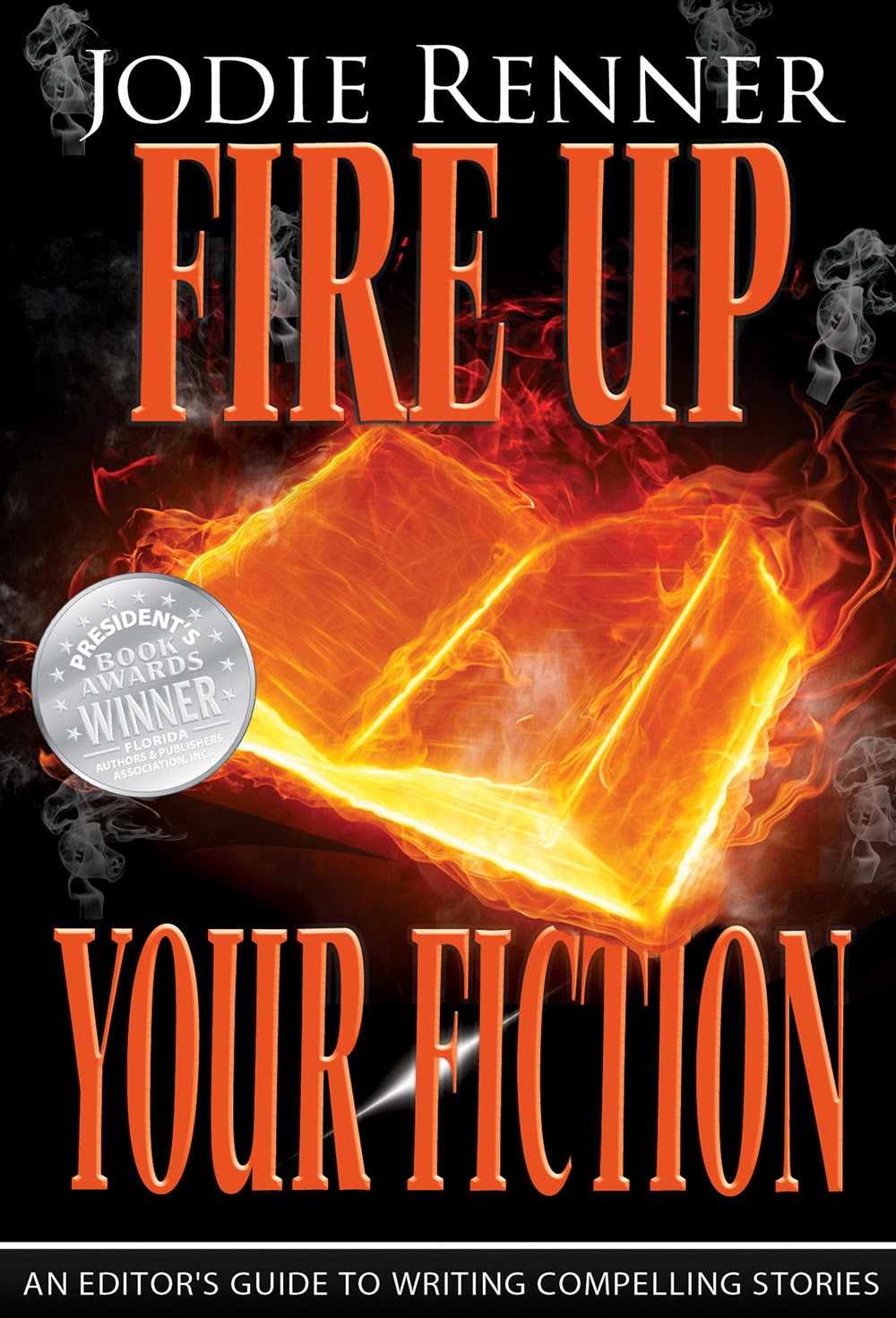
Jodie Renner, a freelance fiction editor specializing in thrillers and other fast-paced fiction, has published two books to date in her series, An Editor’s Guide to Writing Compelling Fiction: WRITING A KILLER THRILLER and STYLE THAT SIZZLES & PACING FOR POWER. Both titles are available in e-book and paperback.

For more info, please visit Jodie’s author website or editor website, or find her on Facebook or Twitter.


Friday, August 26, 2011

Why I Read and Write Crime Fiction

Posted by L.J. Sellers, author of the Detective Jackson mysteries and thrillers
After spending months writing about a bleak future, I found myself feeling depressed and negative. I even considered giving up writing gritty crime novels—if that’s what it took to stay positive. Then while working on a nonfiction book, I came across my notes for a talk I gave at the library called Why I Read and Write Crime Fiction. It reminded me of the genre’s value and why I should continue to write it and why it’s good for readers too, including the president. Here’s a shortened version of my talk.

Crime fiction confronts the realities of life across various cultures more often and more honestly than mainstream/literary fiction does. Crime novels are suited to exploring provocative social issues and showing how those hot-button subjects affect various people’s lives, often from diverse perspectives.

Crime fiction can be surprisingly poignant and analytical about problems such as illegal immigration, human trafficking, and drug use. These novels highlight deep-rooted cultural ills such as racism, sexism, bigotry, and the dangers of stereotypes. Sometimes a mystery will show a stereotype in all its glory, reminding us of why stereotypes exist and how we all fit into one … at least a little bit. The crime genre often forces us to see the world from perspectives that make us think outside our comfort zone.

As crime writers and readers, we get to make sense of things that would otherwise haunt us. We learn why the family next door disappeared one day or what’s really going on in the creepy warehouse across the street. Sometimes that knowledge helps us sleep better and sometimes it doesn’t, but at least we learn one version of the truth.

Police procedurals and thrillers give us a medium through which we can experience the triumph of good over evil. For short while with each story, we get to be the good guy, the hero who rescues the kidnapped child or saves the president’s life. We get to drag the bad guys off to jail or shoot them dead if “they need killing”— fantasies we can’t act out in our everyday lives. The real-world events around us can be unjust and inexplicable. It’s important to our collective mental health to experience justice, order, and revelation through fiction.

Novels with well-written protagonists and antagonists bring us to terms with the duality within ourselves. Humans are all deeply flawed, with the capacity for great goodness as well as for deceit, jealousy, schadenfreude, addiction, selfishness, and often worse. When crime fiction heroes—detectives, FBI agents, and prosecutors—possess such flaws, we not only relate to those characters, we forgive ourselves for the same shortcomings. When a killer calls his mother or pets a stray dog, we hate him a little less and remember to look for good qualities in everyone.

Crime novels explore relationships in a way that few other genres can. What better mechanism to test a bond between husband and wife, parent and child, or lifelong friends than to embroil the relationship in a crime, either as victims, suspects, or perpetrators. Similar to natural disasters, the aftermath of a crime can bring out the best—or worst—in humans.

The genre is also rich with possibilities for exploring the complexity of the human condition. Victims become predators; predators become victims. A person is guilty, but not in the way we’ve been led to believe. Most of all, crime fiction is full of surprises, and we readers love the unexpected. When was the last time a reviewer used the word twist when discussing a literary novel?

Why do you read and/or write crime fiction? Does it ever get you down?


Wednesday, August 24, 2011

Four stars for White Tombs

 By Judith Yates Borger
Alright, I admit it. One of the reasons I like White Tombs by Christopher Valen is because it's set in St. Paul but it's not because I live in Minneapolis. It's because Valen's tale introduced me to a section of town that was fully foreign to me, Hispanic West St. Paul. For all I knew about this part of the Twin Cities, not 10 miles from where I live, it could be Kuala Lampur.

White Tombs is full of detail about the Twin Cities' burgeoning Hispanic community. He even drops in a fair amount of Spanish, which he either translates to English, or gives enough context that translation is unnecessary.

He has one of the better first paragraphs I've read in a while: "Julio Perez sat in a swivel chair behind the mahogany desk in the study of his house on St. Paul's West Side. His eyes were closed and his left cheek was resting on the desktop. Were it not for the bullet hole in his head, one could have assumed he had merely fallen asleep."

Valen's protagonist is Detective John Santana, who obviously is looking for the killer, but just as important has his own demons to exorcise. So as not to have to issue a spoiler alert I won't go into more detail, but suffice it to say, Santana's motivation works well with Valen's plot.


My only complaint about this, Valen's first mystery, is that he uses too many similes. On those occasions he lets writing get in the way of his story telling. That said, he gets off some lovely phrasing, such as he "navigated the slippery sidewalk like a soldier crossing a minefield." And, "the headmaster's secretary, a heavy-set, fifty-something woman who had probably settled for her second choice after considering the nunnery." And "eclipse had turned the full moon into a drop of blood lying on a dark sheet." He also has a white-knuckled chase scene at the end.

I look forward to reading more of Valen's work. White Tombs is published by Conquill Press. Go to www.christophervalen.com for more information.


Monday, August 22, 2011

Back to Three Pines

A Trick of the Light by Louise Penny.

For a tiny village that's not on any maps, Three Pines has more than its share of murders. Even the residents and the police voice that opinion. Luckily, the head of the Murder Squad at the Sûreté du Québec knows the village and its denizens well.

Artist Clara Morrow, who lives in Three Pines, has finally been "discovered" and is having her first solo show at the Montréal Musée d'Art Contemporain. After the show, her husband Peter has organized a party/barbecue in the garden of their home in Three Pines, with dozens of guests, some invited by other guests.

The next day, returning with a pile of newspapers that reviewed Clara's exhibit, Peter finds a body in the back yard. Hidden the night before in a flower bed in a remote corner of the garden, it's quite noticeable in the morning sunshine, due to its bright red dress.

The body is that of a childhood friend of Clara's, with whom she hasn't had contact in many years. Lillian Dyson, unable to succeed as an artist herself, had become a critic known for her cruelty to burgeoning artists. What she was doing at the Morrow's party was a mystery; she had no idea where Clara lived and none of guests admitted seeing her. Because Lillian was so good at alienating people, there is no shortage of suspects for the crime.

Gamache and his second in command, Jean-Guy Beauvoir, once again move their homicide team to the old railroad station in Three Pines in order to investigate. Gamache and Beauvoir are still not completely recovered from the injuries they received in a warehouse raid many months earlier, though Gamache is in much better shape than his deputy. Somehow, though, the two men manage to make use of their inner demons as they solve the puzzle of Lillian Dyson's death in Three Pines.

Each of Louise Penny's Chief Inspector Gamache novels has been outstanding, and each has seemed better than its predecessor. A Trick of the Light is no exception. As she has in the six earlier books, Ms. Penny draws us into the world of Gamache and Beauvoir and their team, and the isolated community of Three Pines. The policemen's relationship with the villagers doesn't hinder them from being objective, and all concerned are aware of this.

The characters are deftly created, as well. Few of them are one-dimensional; Ms. Penny is able to portray even the most minor characters as multi-dimensional.

There are a couple of problems with the book, however. It is necessary to have read the previous books in the series to have a proper understanding of this one (though perhaps reading the six books in the series for the first time is not really a problem). Secondly (and truly sadly), the reader eventually reaches the last page, the last sentence, the last word of the book with the realization that there will be a wait of many months for the next.

A Trick of the Light will be released on August 30, 2011.

*FTC Full Disclosure: Many thanks to the publisher, who sent me a copy of the book for review purposes.

Friday, August 19, 2011

The Care and Feeding of Authors

By Peg Brantley, Author at Work, Stumbling Toward Publication


It's gotta be chocolate, right?

Nuh-uh.

Some kind of booze?

Nope.

But what I'm about to share with you creates an even higher high for those of us who wrangle words. Since I'm not yet published (with 3.375 practice novels stuck in a drawer), I'm taking this opportunity to speak for those who are.

I was talking with a friend the other day who absolutely loves to read. And to anyone who will listen (particularly another reader) she will share her thoughts and bubble with enthusiasm about a particular book or its author. I love spending time with her, especially when I have my Kindle to download samples while we're talking.

But she doesn't write reviews on Amazon. What? She hates reviews that give away plots, doesn't want to commit the time, and can't believe that what she thinks could possibly have any impact. When I told her she could write a review that didn't need to reveal any of the plot (hello . . . Amazon . . . book description), and simply say what she enjoyed about the book, or the writing style, her eyes lit up.

Most writers won't ask a reader to write a review on Amazon, or Goodreads, or anywhere else. But I'm here to tell you that those reviews can make a huge difference to your favorite authors. Maybe even feed them for a month. Now that's power.

My sister, Lala Corriere, whose first book was released for Kindle last November and expects to have her second book released before this November, flew sky-high because some readers, people she'd never met, took the time to write her and tell her how much they'd enjoyed her first book. The fire of passion those few words lit under her butt provided her the loving care she needed at that moment. She was propelled to a higher level of energy. And that's the kind of loving care she'll be able to look back on when she's having a rough day in order to re-energize and motivate. Talk about leftovers!

So here it is:
  • buy their books (duh—this definitely falls under feeding);
  • write reviews. Even three-liners that say, "I liked this book. You might, too! Get it now!" Whether it's on Amazon or Goodreads or an online loop of readers. As readers, you have more power than you realize, and your author will be so appreciative;
  • let the author know if his or her efforts gave you a nice escape, something to think about, or just good beach-reading. A few nice words from you equates to thousands from them. A pretty fair exchange, don't you think?
Even at the point where I am in this career, encouragement is a necessary element to my existance. Just the idea that there are a couple of people out there, ready to give my initial effort a test run, keeps me going. Can you imagine how huge the reality will be?

Feed your favorite authors. Don't be shy. Don't think what you have to say won't possibly make a difference.

I promise you, it will.

Readers, is there something else you've done to feed a favorite author? Are you willing to write a review?

Writers, what keeps you nourished and well fed?


Wednesday, August 17, 2011

Paper or Plastic?

By Andrew E. Kaufman


I admit it—I’m one of them.

I’m talking about e-book enthusiasts, and I’m a card-carrying, flag-waving, dyed-in-the-wool member of the club. I make no apologies for it, either. I love, love, love the Kindle. Not just because I like to read on it—I also make a living from it. Personally, I think they should name a country after Amazon, or at the very least, give them an island.

But I’m a gadget sort of guy (read: tech-nerd), always have been. It’s not that I feel the need to one-up everyone else. I’m not that guy. My reasons are pure and simple: I’m all about anything that makes life easier, and for someone who loves to read—at least from my perspective—it just makes sense. No more lugging cumbersome books around, no more tiny print, and best of all, no more having to drive to the store or wait days for books to arrive. Seems like a win-win sort of thing.

However, not everyone feels that way.

While the number of e-book readers continues to grow each year, there are still many who resist the Great E-book and want nothing to do with it. Now don’t get me wrong—that’s in no way a criticism. A book is a book, and as far as I’m concerned, in any shape or form it will always be a wonderful thing. In fact, I still print paper versions of my novels, and quite honestly, love them. I think there will always be room for both in this world. But what I still don’t get is why some people disagree, why they prefer to cling to only one form. Many say they it’s simply because they love the feel of paper, the smell, love to hold it in their hands. But I have to wonder if maybe it’s something else.

New scares people—it even scares me sometimes—while old provides a sense of comfort. I get that. But there always has been and always will be resistance to the new—that is, until it becomes old. Know what I mean?

Case in point: years back I recall this funny new concept called the Internet. Lots of people thumbed their noses at it, said it would never fly. And look where we all are right now.

I see the same thing happening with e-books. For the first few years people talked about how ridiculous it was, how they just couldn’t see it catching on, how attached they were to their paper books. Well, we know how that turned out. Although Amazon keeps a tight lip on just how many Kindles they’ve sold, others have not. One prediction is that revenues will reach $8 billion by 2012. Yes, that’s billion.

So readers and writers, maybe you can help me understand better: Paper or plastic? And why?

Monday, August 15, 2011

Shoot? Don't Shoot!

The Citizen Police Academy of the Santa Monica Police Department


         With no warning, an ordinary-looking man dropped the “baby” he was carrying in his arms and rushed at me, brandishing a knife. I shot and killed him with the gun I’d been given.

Fortunately, it was only a simulation of a dark alley, and a training exercise that was part of a Citizens’ Academy class. The purpose of the twelve-week course was to demonstrate to ordinary citizens the complexity of police work and explain why the officers you meet react to you as they do. My debut police mystery, No Dice, is set in Santa Monica and I was eager to get the details right.

        Our class of twenty “lay people” was drawn into every facet of police work taught by the people who do the job—from forensics to traffic investigation, the firing range, the jail, the Harbor Patrol—as well as a demonstration of the Israeli self-defense techniques that officers learn.

We had an opportunity to make a simulated traffic stop. I almost sank to my knees when I put on the Sam Browne belt with the mock gun, the flashlight, and the twenty pounds of gear that goes around the waist of every officer.

It may come as a surprise to some that traffic stops are the most dangerous aspect of police work. My task was to get the driver’s documents and return to the cruiser. It was dark as I nervously approached the car, having just seen the driver leap out of the car and “shoot” the classmate who volunteered just before my turn.

This time the officers/actors played it a little drunk. They wanted to argue with me. I found myself becoming hard as nails, Joe Friday tough. Anything could and did happen during these simulations, as it does on the street. I managed to get the documents, but the encounter left me shaken and surprised at how mean and nasty I sounded.

        In a nighttime demonstration by The Special Entry Team, two officers rappelled down the side of a cement tower training facility to approach a parked car in which I volunteered to be “captured.”

I knew it was coming. I still wasn’t prepared to have my ears blown off and flash bangs explode next to me as stealthy black Ninjas suddenly appeared at the door of the car, pointing automatic weapons at me. It happened in a second!

Each week the class engaged with police executives, staff members and especially with patrol officers, the people who know the mean streets of Santa Monica that most of us rarely see. Those mean streets are a matter of perspective.

During my Ride-Along, the officer and I were patrolling the beach parking lots around three a.m. when he left the cruiser to find a young girl lying across the front seat of a new car. He told me at first he thought she was dead. Her story was that she felt safer here sleeping in her car at the beach than in her own home in a downtown Los Angeles neighborhood.

Most of us are unlikely to see a table strewn with packets of crack cocaine, heroin, methamphetamine, and a variety of drug paraphernalia such as the drug detail brought in. If our class was any indication, the sergeant pursues drug offenders with humor and great enthusiasm. They probably don’t find him nearly as amusing as we did.

We saw that same zeal in more than thirty officers and personnel who talked about their work. They really like catching bad guys.

Police work is hard. It wears people out. Events don’t roll out nearly as simply as they appear in the newspapers. Life-changing decisions are made in a second, which juries and lawyers can wrangle over for years afterward. There can be a lot of valid explanations for events, and I’m not so quick to judge anymore.

Check and see whether something like the Citizen Academy program is available where you live. For crime writers, this is a valuable, eye-opening experience and an opportunity to grab. Most people like to talk about what they do, and within real boundaries, so do law-enforcement people.

Note from Jodie: A quick Google search revealed similar Citizen Police Academy courses in many cities across the U.S. and Canada.


Mar Preston, author of crime fiction No Dice, is today’s guest blogger, filling in for Jodie Renner, who recently edited Preston’s second police suspense-mystery, Rip-Off, also set in Santa Monica, California. You can email Mar at marpreston@frazmtn.com, and find out more about her two Detective Dave Mason police mysteries, No Dice, and soon, Rip-Off, at www.marpreston.com.