Showing posts with label write tight. Show all posts

Monday, February 17, 2014

Concrete Tips for Decluttering Your Prose

by Jodie Renner, editor, author, speaker

Lately, I’ve been spending a lot of time decluttering my desk, files, closets, cupboards and drawers in preparation for my upcoming move across the country. It’s been tedious and painful, but now that a lot of it is done, the place looks so much better. And it’s such a relief to be rid of a lot of stuff I wasn’t using anyway, and had forgotten I even had! I feel lighter, less encumbered.

Once you’ve written the first draft of your novel or short story, it’s time to go back and look for places where you may have cluttered up your sentences with little unnecessary words, or your paragraphs with redundant sentences. Excess words in your sentences are like rocks on the road, preventing smooth, unfettered travel. But don’t worry about style or fine-tuning while you’re writing your first draft – just get your ideas down as quickly as you can. Once the whole story is roughed in, you can go back and start ferreting out words that don’t add to the meaning or imagery and are just hampering the fluid flow of ideas.

Also, look for anywhere you may be overwriting or beating a point to death. Say it once – effectively – and then move on. Twice, max. Otherwise you risk annoying your readers, who will say, “Yeah, I got it the first three times!”

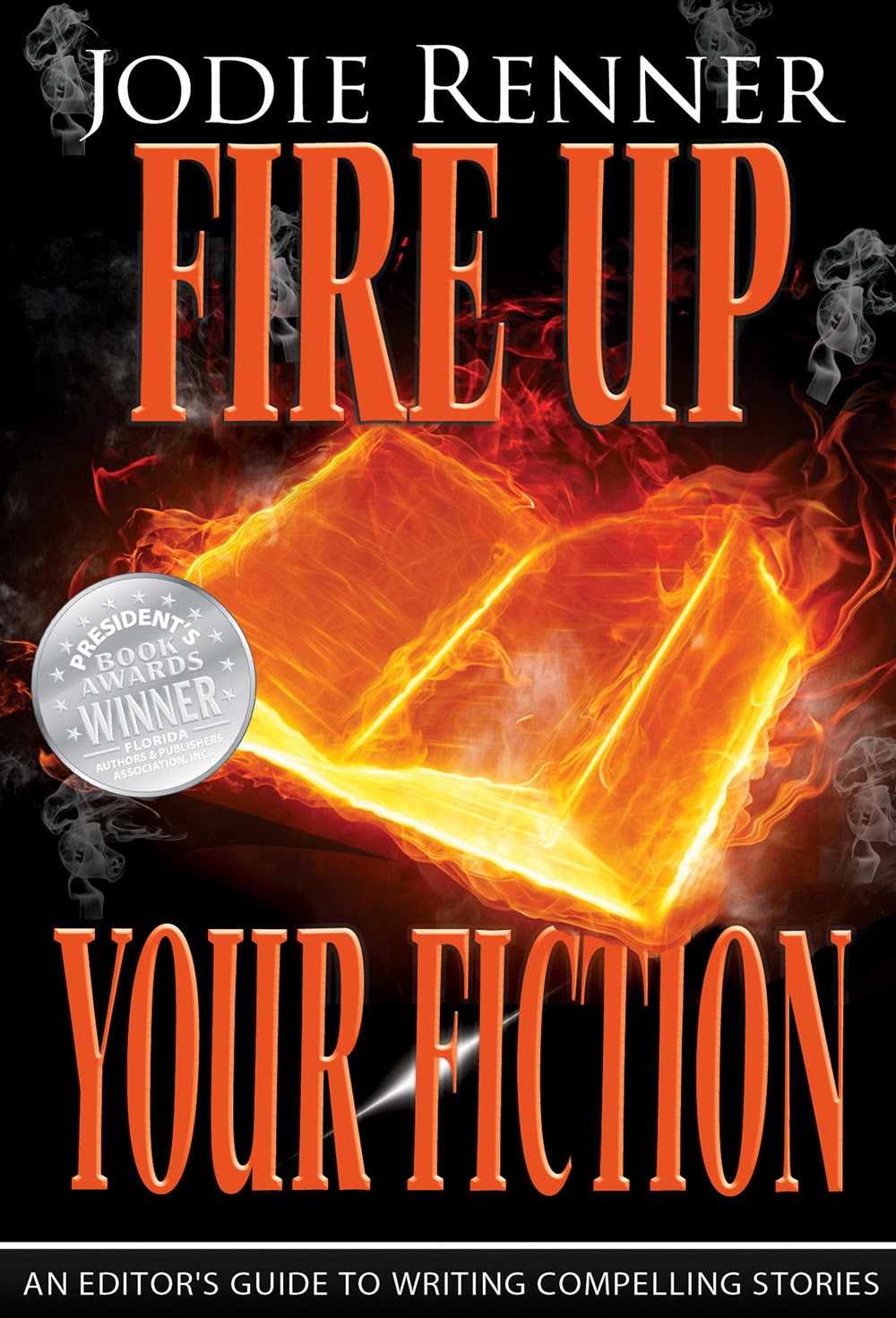
In my editor's guide to writing compelling stories, Fire up Your Fiction, I offer lots of concrete tips with examples for streamlining your writing for a smoother flow and pacing.

Here are some examples from my editing of taking out unnecessary words that just clutter things up. As always, I’ve changed the names and details to provide anonymity for the writers.

 ~ Avoid little-word pile-ups and eliminate redundancies.

Take out the clutter to reveal the essence. Instead of “in spite of the fact that,” just say “although.” Instead of “in the vicinity of,” say “near.” Instead of “in the direction of,” say “to” or “toward.” Instead of “came in contact with” say “met.” Instead of “during the time that,” say “while.” No need to say “located at” – just say “at.”  

Before:
On their cross-country trip, they slept each night in the cheap motels located less than a mile’s drive from the interstate.  

After:
 On their cross-country trip, they slept each night in cheap motels just off the interstate.  

Before:
The car drove slowly through the large complex heading in the direction of a secluded building at the back of the facility. It was located on the shore of the Mississippi River. The vehicle came to a stop next to the entrance to the building.  

After:
 The car drove slowly through the large complex toward a secluded building on the shore of the Mississippi River. It stopped next to the entrance.  

Before:
He was shooting off his mouth in the bar last night telling everybody that he was going to find the bastard that ratted on him.  

After:
 He was shooting off his mouth in the bar last night about finding the bastard that ratted on him.

Before:
 He moved his mouse pointer over to the other email that he had received.  

After:
 He clicked on the second email.  

~ Don’t drown your readers in details.

Leave out those picky little details that just serve to distract the reader, who wonders for an instant why they’re there and if they’re significant:  

Before:
He had arrived at the vending machine and was punching the buttons on its front with an outstretched index finger when a voice from behind him broke him away from his thoughts.

After:
He was punching the buttons on the vending machine when a voice behind him broke into his thoughts.

In the first example, we have way too much minute detail. What else would he be punching the buttons with besides his finger? And we don’t need to know which finger or that it’s outstretched. Everybody does it pretty much the same. Avoid having minute details like this that just clutter up your prose.  

Before:
An angular snarl stuck to his face, the officer indicated with a hand gesture a door that was behind and off to the right of Jason. He swung his head around to look in the direction the officer was pointing.  

After:
Snarling, the officer gestured to a door behind Jason. He turned to look behind him.

~ Take out empty, filler words like “It was,” “there was,” and “there were.”

Before:
I headed down a rickety set of wooden steps to the basement. There was a dim light ahead in the hallway. To the right there were cardboard boxes stacked high. To the left, there was a closed door with a padlock. Suddenly, I heard muffled sounds. There was someone upstairs. 

After:
I headed down a rickety set of wooden steps to the dimly lit basement. To the right cardboard boxes were stacked high. To the left, I saw a closed door with a padlock. Suddenly, I heard muffled sounds. Someone was upstairs. 

I could play around with this some more, but you get the picture. 

~ Take out the word “that” wherever it’s not needed.

Read the sentence out loud, and if it still makes sense without the “that,” remove it. Smooths out the sentence, so it’s less clunky and flows better. 

Before:
She said that you thought that it was too expensive and that you wanted to shop around. 

After:
She said you thought it was too expensive and you wanted to shop around.

~ Delete words or phrases that unnecessarily reinforce what’s already been said.

Before:
We passed an abandoned house that nobody lived in on a deserted street with no one around. The house was gray in color.

After:
We passed an abandoned gray house on a deserted street.

~ Don’t tell after you’ve shown.

She moped around the house, unable to concentrate on anything. She felt sad.

He paced nervously around the room, muttering to himself. He was agitated.

In both instances, the second sentence can and should be deleted. 

~ Condense any long-winded dialogue.

In everyday situations in real life, people don’t speak in lengthy, complete sentences and in uninterrupted monologues. Read your dialogue out loud to make sure it sounds natural, not like a rehearsed speech.

Break up any blocks of one person speaking at length by rewriting it in questions and answers or a lively debate, with plenty of tension and attitude.

Use lots of incomplete sentences and one- or two-word answers, or even silences.

How would those characters actually speak in real life? In general, men, especially blue-collar men, tend to be terser and more to-the-point than women.

 
Jodie Renner is a freelance fiction editor and the award-winning author of three craft-of-writing guides in her series An Editor’s Guide to Writing Compelling Fiction: Captivate Your Readers, Fire up Your Fiction, and Writing a Killer Thriller, as well as two clickable time-saving e-resources, Quick Clicks: Spelling List and Quick Clicks: Word Usage. She has also organized two anthologies for charity, incl. Childhood Regained – Stories of Hope for Asian Child Workers. You can find Jodie at www.JodieRenner.com, www.JodieRennerEditing.com, her blog, http://jodierennerediting.blogspot.com/, and on Facebook and Twitter.

Sunday, September 8, 2013

Don't Insult Your Readers by Overexplaining

by Jodie Renner, editor, author, speaker
 Follow Jodie on Twitter

If you
want to write compelling fiction that sells (and who doesn’t?), when you’re revising, keep an eye (and ear) out for any repetitive sentences and passages and delete them. Resist the urge to explain a point to your readers or say the same thing several different ways, just to be sure they got it.

And if you “show” a character’s feelings (as is most powerful and immediate), no need to follow that up by “telling” readers how they felt, too. That’s overkill and comes across as patronizing. Today’s readers are sophisticated and savvy, so make your point, then move on.
Sure, go ahead and write more leisurely the first time through, exploring different ways to express various ideas or to show character reactions or motivations. But then later, save the doc in a new file and get out your red pen or hover your finger over your “Delete” key and start taking out all those “supporting phrases” that pile up and actually dilute the power of a single phrase or image that stands alone.

Repetition is redundant.
Whether you’re trying to set a mood with imagery, deepen characterization, or advance the plot with action or dialogue, it’s best to just say/show/describe it once—twice maximum—not three or four times.
You may think you’re emphasizing something by repeating it, but even if you say it in different words, the overall impact is diminished. A lot of my editing consists of flagging repetitions of ideas, words, or imagery. And I’m guilty of it myself in my own writing – even editors need editors!
Here’s an example, well-disguised from my editing, of saying basically the same thing three or four or five times within a paragraph.
Before:
Enraged by the CEO’s false accusations, Cheryl struggled to regain control of her emotions. She didn’t often lose her temper but when it happened, she found it difficult to calm down. She had never been so angry at any time in her professional career. Mr. Johnson had pushed her too far when he suggested that she could possibly be involved in stealing those confidential documents. Just thinking about what he said made her blood boil.
After:
Enraged by the CEO’s false accusations, Cheryl struggled to regain control of her emotions. How dare he suggest that she could be involved in stealing those confidential documents? Just thinking about it made her blood boil.
Paring the ideas in the “Before” paragraph down to the essentials increases the power of the message. Repeating it several times actually detracts from the message and dilutes it.
Often less is more, in the sense of having more impact.
RUE: Resist the Urge to Explain
“Resist the Urge to Explain” was coined by Renni Browne and Dave King in their book, Self-Editing for Fiction Writers. Basically, it’s about honing your fiction-writing skills so your dialogue, actions, and evocation of characters’ inner feelings and reactions come to life on the page. Resist the urge to add some clarifications afterward to explain what you meant.
Show, don’t tell:
Show us how the character is feeling or reacting. Then resist the urge to explain (tell) it afterward, just to be sure the reader got it:
Example:
“We will find out who you are. We have eyes and ears everywhere. You are not safe from us.” The click of the line disconnecting underlined the obvious menace of the cold tone and intimidating words of the caller.
What follows the quoted words is overexplaining. Don’t explain to the readers something they already know from reading it themselves. They’ll feel that you’re talking down to them.
This tendency to overexplain can show up in minor ways, like the examples below, where the last sentence in each is superfluous and should be taken out.
 
“You idiot!” she yelled, throwing the picture across the room. She was furious.
 
“You crack me up,” she said, laughing hysterically. Joel could be so funny.
 
She threw herself down on the bed and sobbed into the pillow. She felt miserable.
 
In each instance, the second sentence is not only unnecessary, it detracts from the message of the first. Also, the first sentence shows and the second sentence tells. When you explain emotions and reactions to the reader, it’s as if you’re covering your tracks, in case your initial description or dialogue didn’t show it well enough.
 
So resist the urge to describe (tell) how your character feels. Instead, dramatize (show) it for the reader with precise words and strong imagery.
Same thing with phrases like, “He banged loudly on the door,” or “She whispered softly,” or almost any other “he/she (verb) (-ly adverb). What they say plus their actions or inner reactions should make it clear how they’re feeling, so no need to add the -ly adverb.
 
Subtle is more sophisticated
Rather than stating the obvious, it’s more powerful to hint at it. Often best not to spell it out, especially if it has to do with a character’s inner thoughts or suppressed feelings. Subtext leaves the readers with more satisfaction that they’re successfully reading between the lines.
Don’t patronize your reader.
Readers and writers, do you have any ideas or examples to add?

To share this craft-of-writing article, please click on the buttons in the gray box below.


See my award-winning book Fire up Your Fiction (formerly Style That Sizzles & Pacing for Power) for lots of concrete ideas on paring down your fiction to reveal the powerful core.


Jodie has published two books to date in her series, An Editor’s Guide to Writing Compelling Fiction: Writing a Killer Thriller and Fire up Your Fiction (Style That Sizzles & Pacing for Power), which has won two book awards so far. Look for the third book in the series, out soon. For more info, please visit Jodie’s author website or editor website, her other blogs, Resources for Writers and The Kill Zone, or find her on Facebook, Twitter, and Google+. And sign up for her newsletter.


Sunday, June 2, 2013

Elmore Leonard’s 10 Rules for Writing Fiction

I'm madly trying to finish my updated, expanded (tripled in length) Writing a Killer Thriller, hoping to get it out in print on time for Thrillerfest in NYC in July, where I'm on a panel this year,so I thought I'd bring you some words of wisdom for writers from bestselling thriller author Elmore Leonard.
- Jodie Renner, editor and craft-of-fiction blogger and author

This list is excerpted from Leonard’s well-known article on writing, published July 16, 2001, in the New York Times and available in full here online.

Leonard, as most of you know, is the author of gritty westerns, crime novels and thrillers.  Among his  best-known works are Get ShortyOut of Sight, Freaky Deaky, HombreMr. Majestyk and Rum Punch, which was filmed as Jackie Brown. Leonard’s short stories include ones that became the films 3:10 to Yuma and The Tall T, as well as the current TV series on FX, Justified.

Twenty-six of Leonard's novels and short stories have been adapted for the screen (nineteen as motion pictures and another seven as television programs).
(I’ve condensed Leonard’s explanations under each rule a bit, for the sake of brevity.)

WRITERS ON WRITING;

Easy on the Adverbs, Exclamation Points and Especially Hooptedoodle
by Elmore Leonard

These are rules I’ve picked up along the way to help me remain invisible when I’m writing a book, to help me show rather than tell what's taking place in the story. If you have a facility for language and imagery and the sound of your voice pleases you, invisibility is not what you are after, and you can skip the rules. Still, you might look them over.

1. Never open a book with weather.

If it's only to create atmosphere, and not a character's reaction to the weather, you don't want to go on too long. The reader is apt to leaf ahead looking for people.

2. Avoid prologues.

They can be annoying, especially a prologue following an introduction that comes after a foreword. But these are ordinarily found in nonfiction. A prologue in a novel is backstory, and you can drop it in anywhere you want.

3. Never use a verb other than “said” to carry dialogue.

The line of dialogue belongs to the character; the verb is the writer sticking his nose in. But said is far less intrusive than grumbled, gasped, cautioned, lied. I once noticed Mary McCarthy ending a line of dialogue with ''she asseverated,'' and had to stop reading to get the dictionary.

4. Never use an adverb to modify the verb “said”...

. . . he admonished gravely. To use an adverb this way (or almost any way) is a mortal sin. The writer is now exposing himself in earnest, using a word that distracts and can interrupt the rhythm of the exchange. I have a character in one of my books tell how she used to write historical romances “full of rape and adverbs.”

5. Keep your exclamation points under control.

You are allowed no more than two or three per 100,000 words of prose. If you have the knack of playing with exclaimers the way Tom Wolfe does, you can throw them in by the handful.

6. Never use the words “suddenly” or “all hell broke loose.”

This rule doesn’t require an explanation. I have noticed that writers who use “suddenly” tend to exercise less control in the application of exclamation points.

7. Use regional dialect, patois, sparingly.

Once you start spelling words in dialogue phonetically and loading the page with apostrophes, you won't be able to stop. Notice the way Annie Proulx captures the flavor of Wyoming voices in her book of short stories “Close Range.”

8. Avoid detailed descriptions of characters.

Which Steinbeck covered. In Ernest Hemingway's ''Hills Like White Elephants'' what do the ''American and the girl with him'' look like? ''She had taken off her hat and put it on the table.'' That's the only reference to a physical description in the story, and yet we see the couple and know them by their tones of voice, with not one adverb in sight.

9. Don’t go into great detail describing places and things.

Unless you're Margaret Atwood and can paint scenes with language or write landscapes in the style of Jim Harrison. But even if you're good at it, you don't want descriptions that bring the action, the flow of the story, to a standstill.

And finally:

10. Try to leave out the parts that readers tend to skip.

A rule that came to mind in 1983. Think of what you skip reading a novel: thick paragraphs of prose you can see have too many words in them. What the writer is doing, he's writing, perpetrating hooptedoodle, perhaps taking another shot at the weather, or has gone into the character's head, and the reader either knows what the guy's thinking or doesn't care. I'll bet you don't skip dialogue.

My most important rule is one that sums up the 10.

If it sounds like writing, I rewrite it.

Or, if proper usage gets in the way, it may have to go. I can't allow what we learned in English composition to disrupt the sound and rhythm of the narrative. It's my attempt to remain invisible, not distract the reader from the story with obvious writing. (Joseph Conrad said something about words getting in the way of what you want to say.)

If I write in scenes and always from the point of view of a particular character – the one whose view best brings the scene to life – I'm able to concentrate on the voices of the characters telling you who they are and how they feel about what they see and what's going on, and I’m nowhere in sight.

I especially love that last paragraph of Leonard's. Right on! - Jodie

Readers and writers - what do you think of Leonard's 10 "rules"?

Jodie Renner has published two books to date in her series, An Editor’s Guide to Writing Compelling Fiction: Writing a Killer Thriller and Fire up Your Fiction (Style That Sizzles & Pacing for Power), which has won two book awards so far. Look for the third book in the series, out soon. For more info, please visit Jodie’s author website or editor website, her other blogs, The Kill Zone and Resources for Writers, or find her on Facebook, Twitter, and Google+. And sign up for her newsletter.